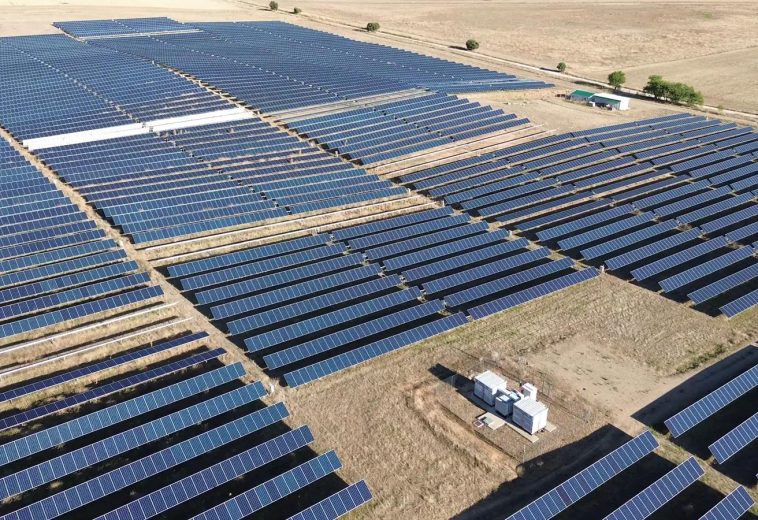
Can renewable energy provide the reliable electricity Africa’s mining industry needs to become more competitive? A major solar-and-battery installation supplying the Kamoa-Kakula Copper Complex in the Democratic Republic of Congo (DR Congo) offers an important example of how clean energy can support large-scale industrial operations.
Located near Kolwezi in the country’s Copperbelt region, the complex is now receiving continuous solar-based power from a 233-megawatt solar photovoltaic plant integrated with a 526-megawatt-hour battery energy storage system. The facility entered commercial operation on 12 August 2026 and is designed to provide the mine with a guaranteed 30 megawatts of baseload electricity around the clock, with output currently reaching approximately 55 megawatts at peak periods.
READ ALSO:Solar Irrigation: Advancing Egypt’s Clean Energy Transition
The project is owned and operated by CrossBoundary Energy, while Germany’s Dhybrid Power Systems provided the battery system engineering and control platform. Its scale demonstrates how private investment and energy technology can be combined to address the electricity requirements of major industrial facilities.
A particularly significant early result is the reduction in diesel consumption. According to project information reported by the system integrator, the facility displaced approximately four million litres of diesel during its first month of operation. This points to the potential financial and environmental benefits of integrating solar generation with battery storage.
For mining companies, dependable electricity is essential. Copper production involves energy-intensive activities, including crushing, processing, pumping and material handling. Interruptions or unreliable supply can affect production schedules, operating costs and the ability to meet delivery commitments.
DR Congo has considerable mineral resources, particularly copper and cobalt, but reliable power remains an important constraint on industrial development. The country’s opportunity is not simply to extract and export minerals; it is to build the energy and industrial systems required to process resources more efficiently and retain greater economic value.
The Kamoa-Kakula installation illustrates how a dedicated renewable energy system can support this ambition. Solar panels generate electricity during the day, while batteries store excess power for use when sunlight is unavailable. This combination helps provide a more consistent supply than solar generation alone.
It also highlights an investment model that could be relevant to other African mining operations. Rather than relying exclusively on national grid infrastructure, mining companies and independent power producers can develop dedicated energy arrangements through long-term commercial partnerships. Such projects can help address immediate industrial requirements while creating opportunities for renewable energy developers, engineers, equipment suppliers and technical specialists.
However, the model should not be mistaken for a complete solution to DR Congo’s electricity challenges. A private power installation serving one mining complex does not resolve wider national shortages or guarantee electricity access for surrounding communities. Expanding reliable power across the economy will still require investment in public grids, transmission lines, generation capacity and distribution systems.
There is also a wider question of how mineral wealth can generate benefits beyond extraction. Copper and cobalt are important materials for electricity networks, electric vehicles and renewable energy technologies. Yet African countries will capture greater value from these resources only if mining investment is accompanied by skills development, local procurement, industrial processing and stronger domestic supply chains.
For DR Congo, the opportunity is to connect mineral production with a broader industrial strategy. Reliable renewable electricity can support mining operations, but it can also strengthen the case for investment in processing, engineering services and related manufacturing activities.
The project’s performance will ultimately be judged by its ability to deliver dependable electricity, reduce operating costs and maintain environmental standards. Its wider significance lies in demonstrating that renewable energy can serve demanding industrial operations, not only households and small businesses.
As Africa seeks to expand its role in global mineral supply chains, the Kamoa-Kakula experience offers a practical lesson: access to reliable energy is central to turning natural resource wealth into sustainable industrial competitiveness.