

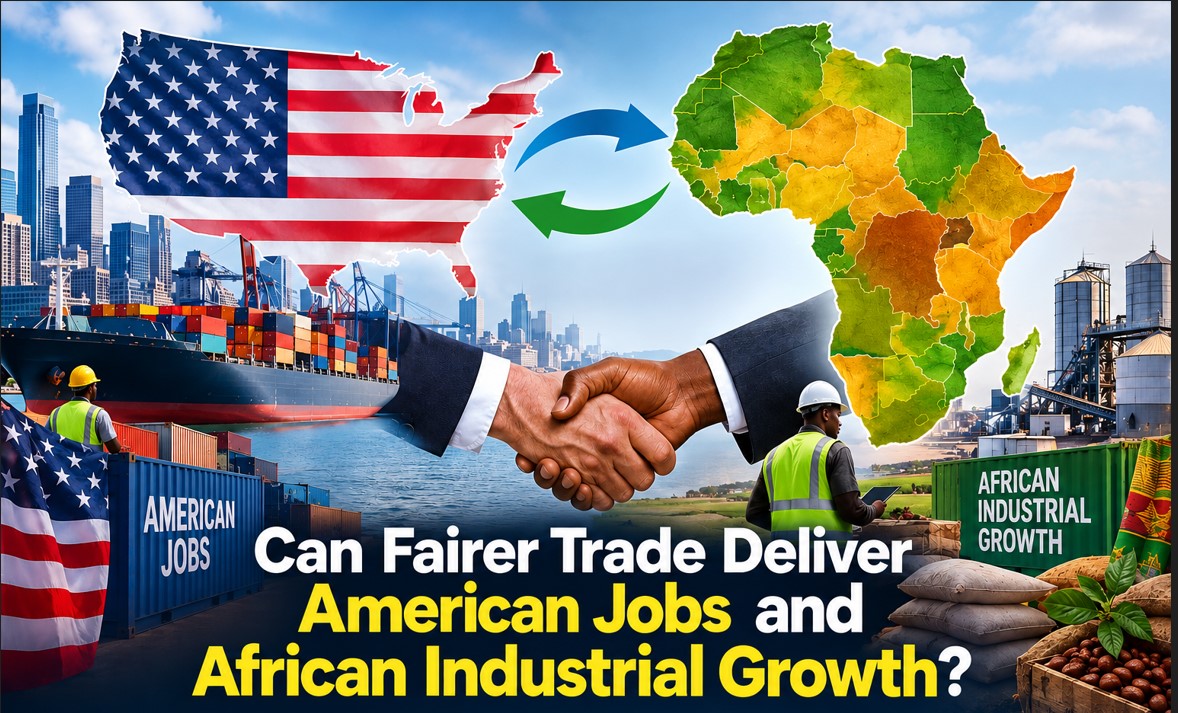
An American machinery manufacturer and an African factory owner need not be rivals. One could supply the equipment that allows the other to process food, weave fabric or manufacture components. Both businesses could expand production and employ more workers. But that outcome depends on trade rules designed to support productive capacity, rather than political theatre centred on who has extracted the biggest concession.
The Trump administration’s April 2025 trade agenda places reciprocal trade, domestic manufacturing and American workers at the centre of its approach. Those priorities deserve serious scrutiny: could a trade agreement strengthen American manufacturing while helping African economies retain more value from what they produce?
The answer is yes, in principle. But fairer trade requires recognising that identical tariff rates between economies with different levels of industrial development do not necessarily create equal opportunities. It also requires acknowledging that some businesses and workers will lose, even when an agreement delivers broader economic gains.
Africa’s experience offers both encouragement and warning. The African Growth and Opportunity Act (AGOA) established preferential access to the American market for eligible sub-Saharan African countries. Unlike a reciprocal free trade agreement, AGOA grants trade preferences unilaterally. Nevertheless, its record offers useful lessons for designing future arrangements.
A 2023 study by the US International Trade Commission found substantial benefits in certain sectors, particularly apparel, including opportunities for women to enter formal employment. Yet the gains were concentrated. Five countries accounted for more than three-quarters of non-crude-petroleum imports under AGOA between 2014 and 2021. The commission described the programme’s overall influence across the region as minimal.
That distinction matters. Export success in a handful of countries is valuable, but it is not the same as continent-wide industrial transformation. Nor does assembling garments from imported fabric necessarily create the local textile mills, technical skills and supplier networks needed to sustain industrial growth.
Also read: Africa’s Critical Minerals: From Resources to Industry
American policymakers must also confront uncomfortable evidence. A separate US International Trade Commission assessment of the tariffs imposed between 2018 and 2021 found that protection increased domestic steel and aluminium production. However, higher input costs also reduced output among American industries that use those metals, with downstream production estimated to have been $3.5 billion lower in 2021.
The study did not calculate the tariffs’ complete economic impact or settle the debate over their national-security merits. It nevertheless exposes a central contradiction: protecting one American factory can increase costs for another. A trade policy that claims to champion manufacturing must account for both effects.
Building a Trade Partnership Around Production
A better US-African trade arrangement would begin by recognising complementary productive strengths.
Consider a food-processing partnership. American firms could compete to supply machinery, African businesses could process crops locally, and exporters could gain more predictable access to customers. African producers would have an opportunity to retain more of the value generated through local processing, while successful American suppliers could gain equipment orders, maintenance contracts and opportunities to provide technical services.
Neither outcome is automatic. Contracts must be commercially viable, financing affordable and equipment appropriate to local conditions. African buyers must remain free to choose competitive suppliers. American jobs should be counted when orders materialise, not inferred from investment announcements alone.
The first practical requirement is certainty. Congress should establish durable preferential market access over a period long enough to support factory investment. Negotiators should specify how trade preferences interact with additional tariffs, so that promised access remains effective under the agreement’s detailed provisions. Transparent eligibility reviews, reasonable notice periods and opportunities to remedy violations would make enforcement more credible and investment less precarious.
Reciprocal trade commitments should then be introduced gradually. African partners could prioritise reducing barriers on productive equipment, simplifying customs procedures and publishing clear procurement rules. More sensitive industries should receive negotiated adjustment periods.
Immediate, comprehensive tariff liberalisation could expose emerging manufacturers to competition before they are ready. Permanent protection, however, could shelter inefficient businesses and penalise consumers. Regular reviews should assess productivity and competition before safeguards are extended.
Making African Production Count
Second, agreements should recognise genuine African production without imposing supply-chain requirements that local industries cannot yet meet.
Rules of origin determine whether goods qualify for preferential treatment based on where and how they are produced. Requirements that are too restrictive can make preferences commercially unusable. Requirements that are too permissive can allow goods to pass through a country with little meaningful local processing.
Regional cumulation offers a practical compromise. Under this arrangement, qualifying inputs from participating African countries can count towards a product’s origin requirements. This would allow manufacturers to source components across borders while meeting the conditions for preferential access.
Auditable production requirements should discourage transshipment, in which goods are routed through a country without sufficient transformation to qualify as originating there. At the same time, gradual incentives could encourage businesses to develop local suppliers and deepen regional production networks.
The objective should be to expand African industrial capability while allowing American suppliers to compete for opportunities as that capability grows.
Third, Washington should support African regional integration. Factories serving several neighbouring markets can benefit from economies of scale that smaller, isolated national markets may not support. Bilateral agreements should therefore accommodate regional supply chains and avoid conflicting requirements that force businesses to maintain multiple, expensive compliance systems.
The World Bank’s 2020 modelling estimated that full implementation of the African Continental Free Trade Area (AfCFTA) could increase regional income by $450 billion by 2035. Approximately $292 billion of the projected gain would come from trade facilitation, including simpler border procedures.
These figures are conditional projections, not realised gains. Nevertheless, they highlight an important point: the benefits of trade depend on more than tariff reductions. Efficient borders, predictable regulations and the ability to move goods across markets are equally important.
Investment, Infrastructure, and Accountability
Fourth, market access must be accompanied by practical investment. Reliable electricity, efficient ports, testing laboratories and technical training should qualify for carefully assessed development finance where appropriate.
Governments should publish project costs, competitive tender results and expected economic benefits. Public guarantees must be assessed against the risks they transfer to taxpayers. Poorly selected infrastructure can leave countries with debt and factories without customers.
Also read: Africa Finance Corporation and Bank of America Lead Insightful Discussion on Climate Finance Funding for Africa
Negotiators must also account for the groups that could lose out. American manufacturers facing increased competition from imports may resist concessions that benefit equipment exporters. African governments could lose customs revenue before alternative tax sources are fully developed. Consumers may benefit from cheaper goods even as particular communities lose jobs.
Adjustment measures should therefore form part of the agreement’s economic planning. Depending on the circumstances, these could include retraining, temporary income support and assistance to governments managing revenue transitions. The costs should be assessed and budgeted for rather than left until problems emerge.
Labour and environmental protections also require credible enforcement. Firms should not gain a competitive advantage through unsafe workplaces, restrictions on workers’ right to organise or pollution imposed on poorer communities. Accessible complaints procedures, transparent investigations and proportionate penalties can protect workers and responsible businesses alike.
Finally, governments should publish an annual scorecard measuring additional American export orders, sustained employment, African domestic value added, wages, supplier development and public costs. Independent evaluators should assess what would probably have happened without the agreement. Rising trade volumes alone cannot establish success.
From Trade Promises to Productive Growth
Fairer trade can deliver American jobs and African industrial growth, but only through an agreement that acknowledges the costs and measures the results.
The strongest expression of reciprocity would be a partnership in which both sides expand their productive capacity. An African factory opening can generate orders for American machinery manufacturers. Those orders can support jobs, after-sales services and further investment, while African businesses develop processing capabilities, technical skills and stronger regional supply chains.
The opportunity is real, but it will not be secured by tariff concessions or political announcements alone. It requires predictable rules, competitive investment, functioning infrastructure and accountability for the results.
Trade policy should make that partnership commercially viable, then demonstrate that American and African workers share in the gains.