I still remember the first time I met Dr. Ken Giami. It was a quiet evening years ago, and our conversation turned naturally to the future of Africa. At a time when discussions were dominated by competing ideologies and cautious optimism, Giami stood out—not because of loud rhetoric, but because of his burning passion and remarkable clarity of vision.
Where others focused on Africa’s problems, he spoke of possibilities. Where some perceived dependency, he saw untapped potential. His conviction was raw, compelling, and unforgettable—and it immediately endeared him to me.
Since then, I have watched him transform conviction into movement. Through the African Leadership Organization (ALO) and African Leadership Magazine, Giami has built more than institutions—he has built mirrors. For too long, Africa’s story has been narrated from the outside, filtered through stereotypes of poverty, conflict, and helplessness. Giami insisted on platforms where Africans could tell their own stories in their own voices, with global resonance.
For more than a decade, Giami has positioned himself not simply as a publisher but as a “bridge-builder.” His summits and forums—from London to Addis Ababa—are designed to connect African governments and businesses with global partners, while also highlighting homegrown success stories that challenge lingering stereotypes of poverty, instability, and dependency. His annual Africa Summit London has become a premier platform for heads of state, ministers, and CEOs to set agendas, debate strategies, and showcase reforms. And the African Persons of the Year designed to celebrate the best of the continent annually has become a household name and event for the continent.
His annual Africa Summit London is one such platform. There, presidents, ministers, and entrepreneurs gather not to plead for sympathy, but to strategise for competitiveness and transformation. “Africa does not need sympathy. Africa needs partnership. It does not need handouts, it needs access. It does not need pity, it needs fair competition,” Giami has said, distilling his philosophy into the rallying cry he calls Africa Forward.
Through African Leadership Organization, he has also built institutional structures that go beyond storytelling. The group provides consultancy services in investment facilitation that has surpassed $ 5billion till date and public-sector transformation, working with African governments to improve governance systems and attract foreign partnerships. This dual role—of publishing narratives and shaping real-world outcomes—has helped Giami become a trusted interlocutor between policymakers and investors.
What makes him remarkable is not only his access to leaders or his ability to convene. It is his unwavering belief in Africa’s youth. Long before “demographic dividend” became the language of economists, Giami recognised that the continent’s most valuable resource was not oil, gas, or minerals—it was its young people. He saw in them the restless energy that, if harnessed, could power the continent into a new era.
Giami’s vision is not limited to glossy conferences or ceremonial awards. His organisation runs social impact initiatives such as the Send a Child to School programme, which supports underprivileged students across several African countries. The gesture may seem small compared to the scale of Africa’s educational deficit, but it reflects Giami’s belief in coupling big-picture advocacy with tangible community impact.
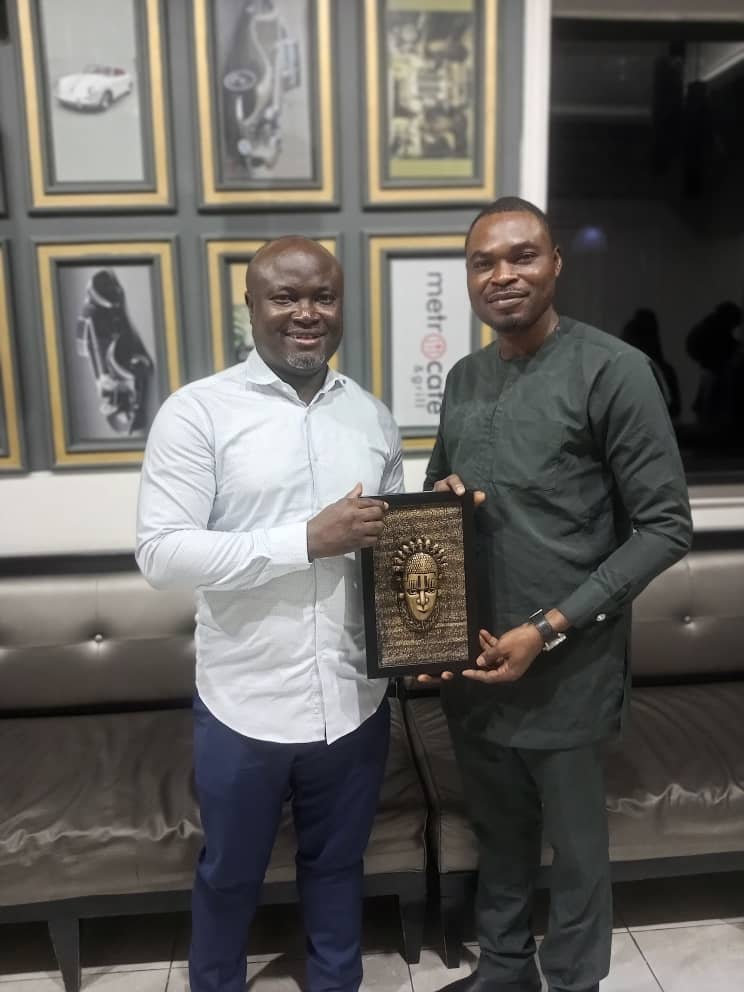
That belief led him to establish the African Youth Hub, a platform that has quietly become a pipeline of leadership. Across the continent, hundreds of young Africans have benefited from mentorship, training, and opportunities through the Hub. For Giami, it was never enough to simply speak of youth empowerment—he built a structure where it could happen. In amplifying the voices of young Africans, he invests not only in individuals, but in the collective future of the continent.
Giami’s work is not without its critics. Some question whether celebrating leadership risks complacency, or whether advocacy can blur the lines with journalism. But in Giami’s case, recognition is not vanity; it is accountability. He has consistently used his platforms not to entrench privilege, but to open doors. He understands that narrative is not a byproduct of politics and economics—it is a driver of them. And he has shown that how Africa is perceived abroad shapes how it can act at home.
As a journalist and editor, I have chronicled African leadership for over two decades. I know how rare it is to encounter leaders who speak the language of transformation and then work, relentlessly, to embody it. Giami’s vision is not perfect, and his mission is unfinished. But his sincerity has never been in doubt.
When I reflect on that first meeting years ago, I understand why his words lingered. They linger because they were more than words. They were a roadmap. And in the years since, Giami has taken the hard road of turning ideals into institutions, and institutions into impact.
On this occasion of his birthday, it is worth celebrating not just the man but the movement he represents. Africa still faces daunting questions—about governance, inequality, and the pressures of rapid population growth. Yet in leaders like Dr. Ken Giami—bold, unapologetic, and steadfast in their faith in the youth—we catch a glimpse of what the continent’s story can become: not one defined by its past, but one authored by its next generation.