Africa is rewriting its place in the global economy amid fierce resource competition and a renewed push for self-reliance. This raises a vital question: how can continental sovereignty deliver real, everyday economic opportunity?
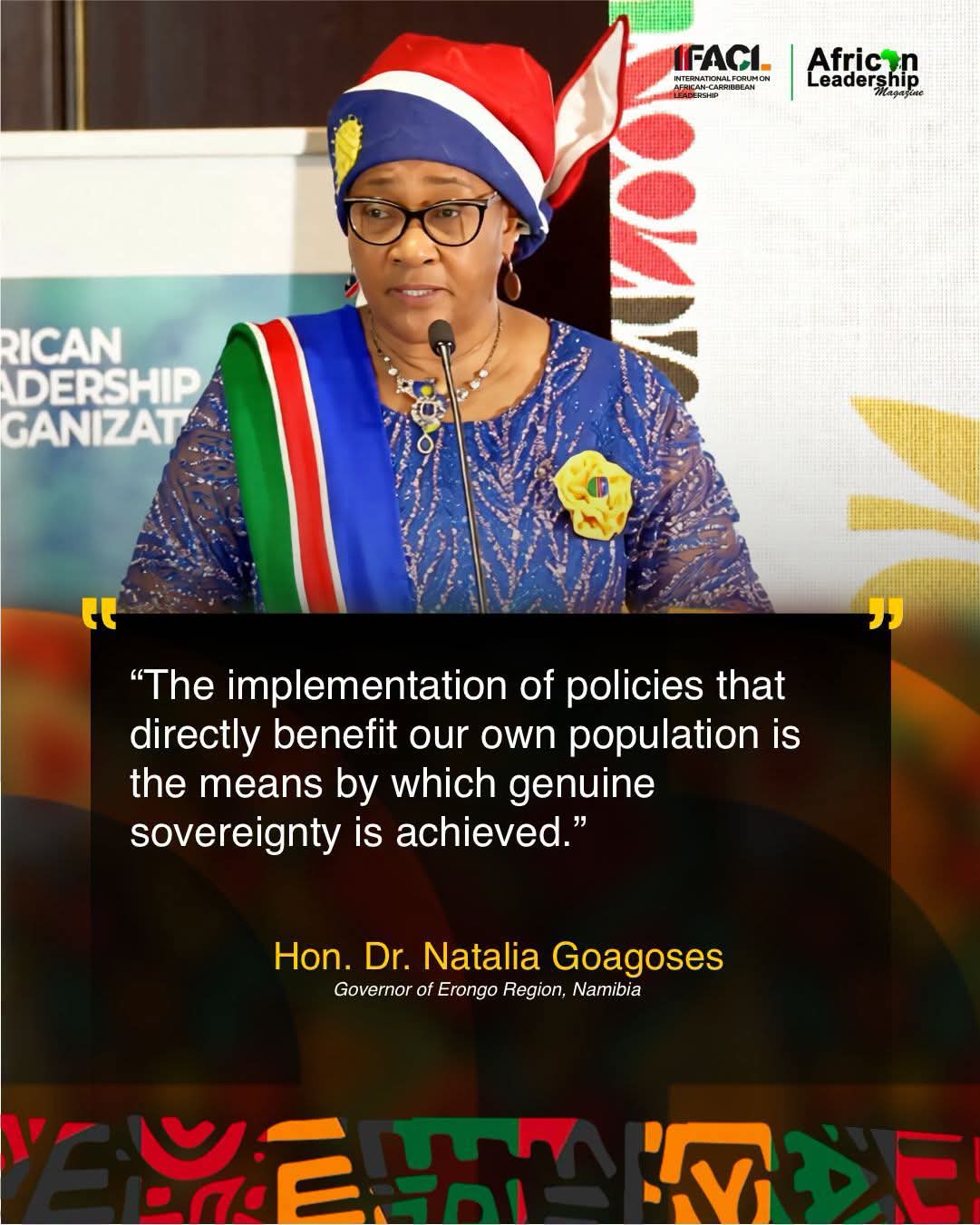
In this address at the 2026 International Forum on African-Caribbean Leadership in New York, Hon. Dr. Nathalia /Goagoses, Governor of Namibia’s Erongo Region, brings the discussion down to the level where national policies are implemented and citizens experience their practical consequences.
READ ALSO: Hon. Dr Nathalia Goagoses Receives Special Congressional Commendation at IFAL 2026
Drawing on Erongo’s experience in water security, fisheries, infrastructure, resource development and regional connectivity, the Governor argues that sovereignty must extend beyond political independence to include economic participation, ownership and value creation. She highlights public-private partnerships, youth and women’s enterprise development, cross-border cooperation and the strategic importance of the Port of Walvis Bay and its corridors to landlocked African economies.
Her address also places Namibia’s experience within the wider ambitions of African integration and South–South cooperation, pointing to the African Continental Free Trade Area (AfCFTA) as a framework through which African countries can deepen trade, investment, technology transfer and economic partnerships.
SPEECH
Hon. Dr. Nathalia /Goagoses
Governor of the Erongo Region, Republic of Namibia
IFAL 2026 – Public Sector & Subnational Leadership Spotlight
Theme: “The Global African Alliance: Reimagining Solidarity, Sovereignty & South–South Cooperation”
24 September 2026
Marriott Marquis, Broadway, New York
During United Nations General Assembly Week
Esteemed Guests, Your Excellencies, Ladies and Gentlemen,
During this critical United Nations General Assembly Week, it is a profound honour to address the International Forum on African-Caribbean Leadership.
I wish, from the outset, to express my sincere appreciation for the kind invitation and nomination to participate in this important international platform. It is a privilege to share this stage with distinguished leaders from across Africa, the Caribbean and the Global South.
Permit me to extend, from the outset, the cordial greetings of the people of the Erongo Region and Her Excellency Dr. Netumbo Nandi-Ndaitwah, President of the Republic of Namibia.
I also extend my warmest regards to His Excellency Alhaji Mai Mala Buni, my esteemed co-panellist in today’s Public Sector Spotlight.
I further wish to acknowledge the distinguished leadership and representatives from the Erongo Region who continue to contribute to the development of its communities.
MAKING SOVEREIGNTY TANGIBLE
Our theme encourages us to reimagine the concepts of sovereignty, solidarity and South–South cooperation.
I approach this from the perspective of subnational governance, because it is at the regional and local level that national aspirations become tangible in the daily lives of individual citizens.
The implementation of policies that directly benefit our people is the means by which genuine sovereignty is achieved.
For Namibia, sovereignty is not only about political independence. As Her Excellency President Netumbo Nandi-Ndaitwah has stated, “ours is the struggle for economic emancipation.”
In Erongo, this means asking a practical question:
How do our minerals, fisheries, port infrastructure and other natural resources translate into greater opportunities and ownership for our people?
Our answer is beneficiation, value addition and participation—ensuring that more value is created here, more opportunities reach our communities, and our people become active participants in economic value chains.
While national government establishes the laws and policies, subnational government is closest to the people and is where these policies are translated into practical opportunities, participation and ownership.
As our late President, His Excellency Dr. Hage G. Geingob, used to remind us:
“People don’t eat policies.”
For us in Erongo, this means turning policy into water security, jobs, enterprise, infrastructure and economic participation.
GOVERNMENT, BUSINESS AND COMMUNITY
The partnership between government and the private sector is crucial, because government cannot do this alone.
Erongo provides a practical example of this partnership. Our businesses and private-sector players are supporting initiatives that empower communities, create opportunities and strengthen local economies.
As Her Excellency President Netumbo Nandi-Ndaitwah has emphasised:
“When communities are empowered, businesses will flourish; when communities are weak, businesses will collapse.”
This reminds us that community development and private-sector growth are not competing objectives. They are mutually dependent.
When we strengthen our communities, we strengthen the market.
When we create opportunities for our people, we create stronger consumers, entrepreneurs, workers and business partners.
For us in Erongo, public-private partnership is therefore not simply about financing projects; it is about building an economy in which government, business and communities create value together.
This is how sovereignty becomes tangible in Erongo.
The Erongo Region is one of Namibia’s most prosperous regions, due to its strategic assets, prominent tourism destinations and abundance of mineral resources, including the Port of Walvis Bay.
Nevertheless, the realities and challenges of destitution within our communities persist, despite this immense prosperity.
Our duty as a subnational government is to ensure that marginalised populations are integrated into the mainstream economy, thereby ensuring that the sovereign people of Namibia directly benefit from our natural resources.
TURNING PRINCIPLES INTO ACTION
We have implemented specific, practical interventions in Erongo to translate these high-level principles of sovereignty into tangible action.
Guaranteeing the Security of Our Water Supply
Namibia is an arid nation, and the Erongo Region is a desert region in which water is essential for economic growth, food security and social well-being.
We established the Erongo Water Forum to facilitate critical dialogue by bringing together national water providers, external experts and the private sector in order to address our water challenges.
We are utilising desalination facilities to address our water issues by looking towards the Atlantic Ocean.
A second water desalination plant is expected to be operational in the final quarter of this fiscal year.
Improving Rural Economies Through Ownership
Despite the fact that fish is a primary commodity from our shores, our local communities in rural areas have not historically consumed or benefited sufficiently from it.
In order to address this issue, we implemented the Fish Consumption Promotion Project, a flagship empowerment initiative.
We are providing young Namibians and women with equipment, initial stock and seed capital to enable them to directly own fish-related businesses.
This initiative ensures that our people become active participants in the economic value chain rather than mere recipients of development.
It shifts the paradigm from government dependence towards enterprise ownership and self-reliance.
FROM POLITICAL COMMITMENT TO AFRICAN INTEGRATION
Africa must unite not only through political commitments, but through practical measures that improve the lives of our people and strengthen intra-African relations.
A meaningful example is the cooperation between Namibia and Botswana.
Our two countries have strengthened the movement of people across our common border, allowing citizens to travel using national identification documents rather than requiring passports for ordinary cross-border movement.
This is what African integration should look like:
Our borders should facilitate connection, trade and people-to-people relations, while respecting the sovereignty of each state.
The African Continental Free Trade Area, or AfCFTA, and our broader Global African Alliance must be established on the basis of these subnational initiatives.
Namibia is connected to international markets and landlocked countries, including Botswana, Zambia, Zimbabwe and the Democratic Republic of Congo, by Erongo’s strategic infrastructure, particularly the Walvis Bay Corridors.
Through cooperation, landlocked countries can become land-linked.
Namibia has made land available at the Port of Walvis Bay for dry-port facilities serving neighbouring countries.
Botswana, Zambia and Zimbabwe have developed or been allocated dry-port facilities and operational space connected to the Namibian port system.
In June 2025, Namibia exported its first shipment of 45,000 tonnes of salt to Nigeria under the AfCFTA.
This was not simply a shipment of salt.
It was an example of an African country using an African trade framework to access another African market.
Namibia has already demonstrated what this can mean in practice.
Consequently, in order to facilitate the exchange of knowledge, technology, investment and practical solutions across the Global South, South–South cooperation must surpass diplomatic engagement.
BUILDING AFRICA FROM THE GROUND UP
Esteemed Guests, Your Excellencies, Ladies and Gentlemen,
In conclusion, the enduring character, hard work and capacity of our people and institutions are underscored by the incorporation of Erongo’s leadership in the Top 25 African Leading Governors Yearbook 2026.
It demonstrates that Africa’s transformation occurs in regions where water security is addressed, young people are empowered, and infrastructure connects markets.
Subnational governments establish the grassroots resilience necessary for genuine continental solidarity by securing essential infrastructure and empowering citizens with direct economic ownership.
Let us ensure that the continent’s wealth is translated into prosperity for all its inhabitants by persisting in the construction of a powerful, independent Africa from the ground up.