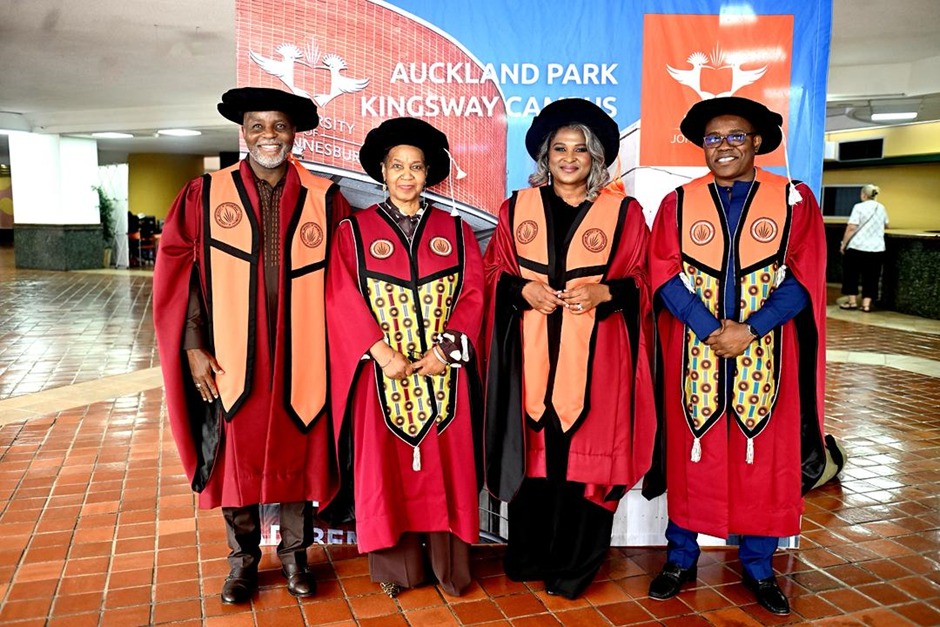
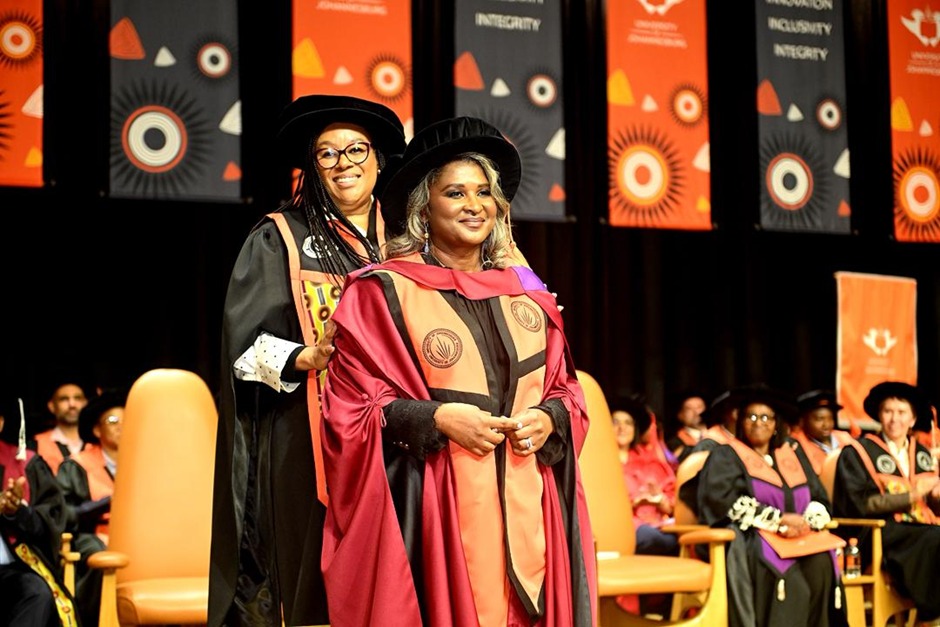
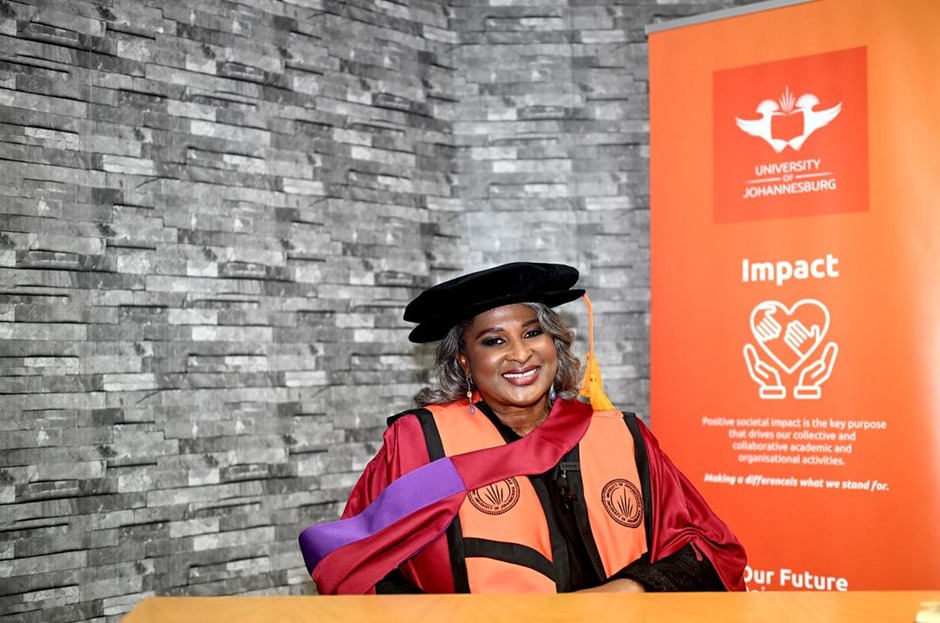
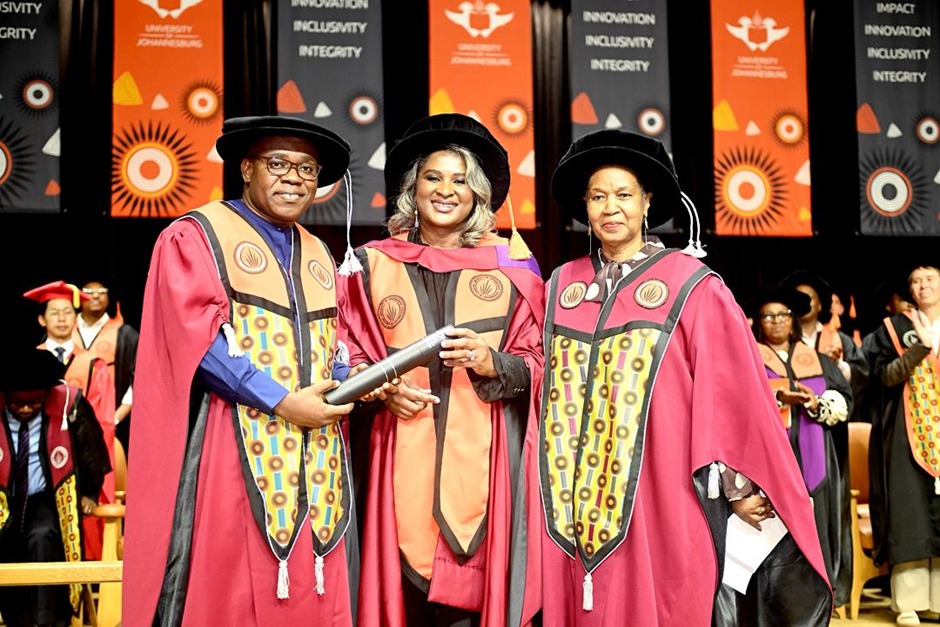
At the University of Johannesburg (UJ) on 16 March 2026, the conferral of an honorary doctorate on Namibia’s former First Lady, Monica Geingos, carried more than ceremonial significance. Beneath the recognition lay a deeply personal moment shaped by the absence of her late husband, Hage Geingob, whose influence remained profoundly present.
Geingos acknowledged the emotional weight of the occasion. “It’s not just the expectation that UJ places on me to continue my work, but something deeply personal,” she said. Reflecting on her husband’s wish to supervise her doctoral journey after public office, she added: “It is a reminder from him that I still have work to do… The journey continues.”
READ ALSO: Online Educational Platform Developed for Professional Adult Educators in Africa
Her remarks underscored the dual meaning of the honour, not only as recognition of past achievements, but as a renewed call to action.
During her tenure as Namibia’s First Lady (2015–2024), Geingos redefined what is often perceived as a ceremonial role, transforming it into a platform for policy engagement and measurable impact. With a background in law, finance, and governance, she approached the office not as a stage for visibility, but as an instrument for intervention.
Through initiatives such as the One Economy Foundation and the #BeFree Movement, she focused on youth empowerment, sexual health education, and HIV/AIDS awareness—critical issues across sub-Saharan Africa. Her work has consistently targeted root causes, addressing stigma, access to information, and structural inequality.
While First Lady-led initiatives across Africa often face scrutiny over sustainability beyond individual tenures, Geingos’ model, anchored in data-driven strategies and global partnerships, has demonstrated a degree of continuity and institutional credibility.
Central to her advocacy is Africa’s defining demographic reality: its youth population. “In the next 20 years, one in four of the global population will be African,” she noted, while cautioning against simplistic assumptions.
“That doesn’t mean one in four of the global workforce will be African,” she said. “For too long, young Africans have been viewed either as a source of labour or as a risk. We must begin to recognise the immense potential they represent.”
This perspective reflects a broader shift in development thinking, from population growth to human capital investment. It also highlights a persistent policy gap: the inability of many African economies to adequately educate, absorb, and empower their growing youth populations.
For Geingos, this is not rhetorical positioning but a strategic imperative. Without deliberate investment in education, healthcare, and economic inclusion, Africa risks missing a defining opportunity.
Unlike many public figures, Geingos’ influence spans law, private enterprise, and public advocacy. This cross-sector experience has been central to shaping her leadership philosophy.
“It has been consequential,” she reflected. “All the roles I have held have taught me three things: develop resilience, manage risk and conflict, and make decisions grounded in data and evidence—not emotion.”
This emphasis on evidence-based leadership is particularly significant in policy environments often shaped by political expediency. It aligns with a growing demand for technocratic competence within African governance structures.
Her message to young women—particularly Black African women—was equally pragmatic. Resilience, she stressed, is essential. She urged them to “learn to take the punches and to know when to throw them,” capturing the realities of navigating professional and societal barriers.
Geingos’ impact extends well beyond Namibia. Her appointment as a UNAIDS Special Advocate for Young Women and Adolescent Girls in 2016 positioned her at the forefront of global health diplomacy, where she has championed gender equity and HIV prevention.
Her tenure as President of the Organisation of African First Ladies for Development (OAFLAD) from 2022 to 2024 further amplified her influence. In that role, she worked to align advocacy efforts across the continent, particularly in health and gender equity.
Yet, the broader challenge persists: translating advocacy into enforceable policy. While platforms like OAFLAD provide visibility and coordination, their effectiveness ultimately depends on political will at the national level. Geingos’ leadership illustrates both the potential—and the limits—of soft power in driving systemic change.
Addressing graduates at UJ, Geingos turned to the demands of an evolving global landscape. “The critical skills for the future,” she said, “are the ability to process, internalise, and apply information quickly.”
Her observation reflects a shift in the nature of work, where adaptability, analytical thinking, and information literacy are as valuable as technical expertise. For African graduates entering a competitive global economy, these capabilities are indispensable.
In accepting the honorary doctorate, Geingos framed the award not as a culmination, but as a responsibility. It is, she said, “a call to continue my purpose and to remain worthy of the confidence placed in me.”
This framing is significant. In contexts where honours are often treated as endpoints, Geingos presents recognition as a starting point for renewed accountability.
UJ’s decision to honour her reflects a broader acknowledgement of leadership at the intersection of policy, advocacy, and social impact. It also raises a critical question: how can such individual efforts be scaled and sustained?
For Geingos, the answer lies in persistence. The work, as she emphasises, is far from complete.
In that sense, the honorary doctorate is not merely a tribute to past achievements, but an endorsement of the work that still lies ahead.