Ethiopia has begun construction of a major new international airport in the town of Bishoftu, about 45 kilometres south-east of Addis Ababa, in a project that officials say will become the largest airport in Africa when completed. The development marks one of the most significant infrastructure investments in the country’s history and is expected to reshape Ethiopia’s role in regional and global aviation.
With an investment of about US$12.5 billion, Bishoftu International Airport is projected to become the largest aviation infrastructure project in African history upon its completion, with the capacity to serve up to 110 million passengers annually, more than four times the throughput of the current Bole International Airport.
READ ALSO: Wakjira Amante: Building Confidence in Ethiopia’s Investment Sector
This project highlights Ethiopia’s determination to bolster its position as a continental and global aviation hub. It comes at a moment of rapid regional air travel growth, strong performance by Ethiopian Airlines, and increasing demand for expanded connectivity between Africa, Europe, the Middle East, Asia and the Americas.
At the heart of this transformative initiative is the vision to supersede Bole International Airport, whose capacity of roughly 25 million passengers per year is expected to reach saturation within the next two to three years owing to sustained growth in passenger traffic. Bishoftu International Airport is designed with four runways and parking space for up to 270 aircraft, along with expanded cargo facilities and logistics infrastructure critical to modern air hubs.
The new airport’s first phase will handle approximately 60 million passengers annually. Once fully developed, it will accommodate 110 million passengers per year, positioning it among the busiest airports globally and eclipsing many long-established hubs.
For comparison, Atlanta’s Hartsfield-Jackson Airport, long ranked the world’s busiest, handled around 93 million passengers in 2024. If Ethiopia’s project meets its targets, Bishoftu will rival and surpass several major aeronautical centres in traffic volume. This is not merely expansion; it is strategic positioning for a new era of connectivity.
The financing structure of the airport underscores both national commitment and international confidence in the project’s viability. Ethiopian Airlines, the state-owned carrier recognised as Africa’s largest airline by destinations served, will contribute about 30 per cent of the total capital. The remaining 70 per cent will be sourced from a range of international lenders, with the African Development Bank pledging at least US$500 million and leading efforts to secure US$8.7 billion from global partners.
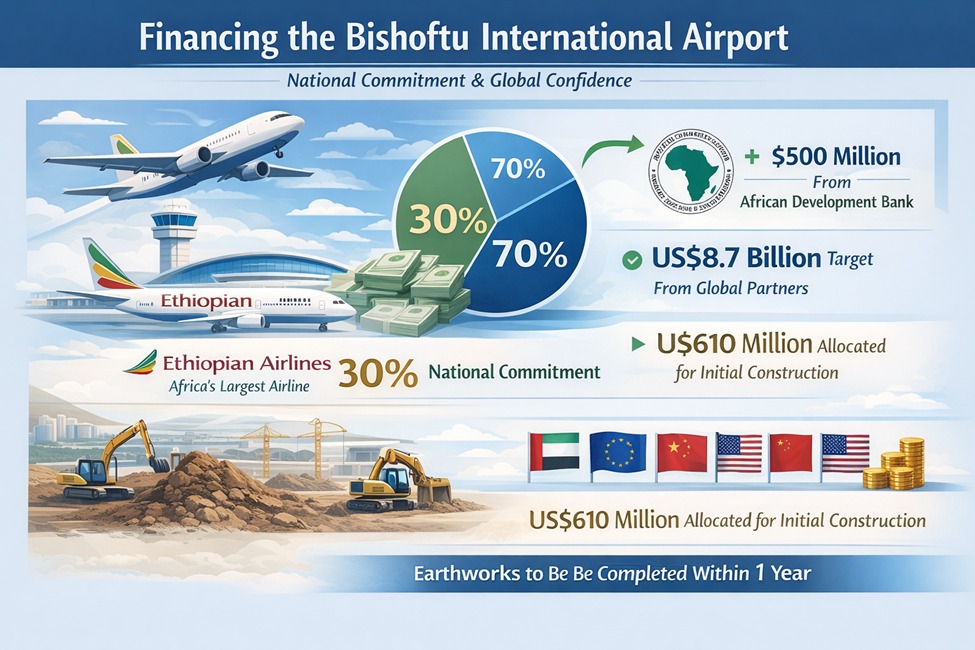
Interest in funding has reportedly come from institutions and investors spanning the Middle East, Europe, China and the United States, reflecting broad confidence in the project’s long-term economic impact. Initial earthworks, financed through an allocation of approximately US$610 million, are expected to conclude within a year, with full construction activity set to intensify thereafter.
The airport’s financing journey also aligns with Africa’s broader economic aspirations, in which enhanced infrastructure is viewed as a catalyst for trade, tourism, logistics integration and industrialisation.
Global Aviation Trends and the African Opportunity
Ethiopia’s airport project must be understood within a wider global aviation context shaped by an unprecedented resurgence in air travel. Worldwide passenger traffic has surged to forecast levels of approximately 9.8 billion travellers, marking one of the strongest rebounds in the history of commercial aviation. This represents a year-on-year growth of about 3.7 per cent, underscoring how decisively global mobility has recovered following the disruption of the COVID-19 pandemic. The scale of this resurgence was symbolically captured when global aviation came close to crossing the ten-billion-passenger threshold, cementing air travel’s return as a cornerstone of global economic activity.
This growth has not been evenly distributed. International travel has expanded more rapidly than domestic traffic, with cross-border passenger volumes rising by an estimated 5.3 per cent, compared with approximately 2.4 per cent growth in domestic markets. This divergence reflects the renewed appetite for long-haul travel, tourism, trade and global business engagement. The Asia-Pacific region has emerged as the principal engine of this recovery, recording the strongest growth globally, driven largely by intensified intra-regional travel and the reopening of major aviation corridors.
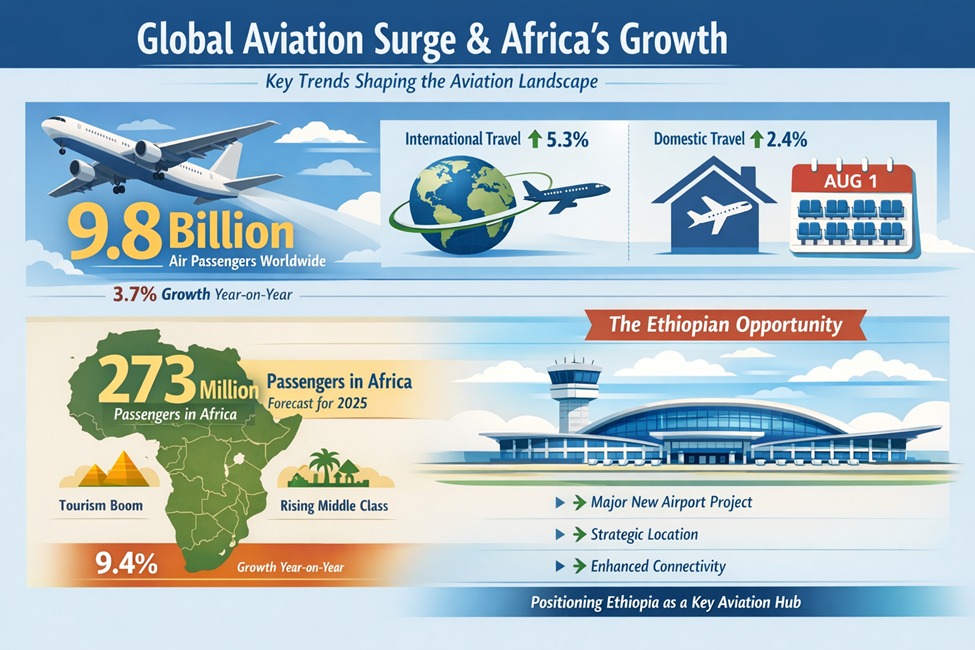
The intensity of demand has also pushed aviation systems to record operational peaks. At the height of the travel season, global aviation experienced its busiest single day on August 1, 2025, with more than 19.8 million airline seats available worldwide, a figure that illustrates both the scale of demand and the pressure being placed on existing airport infrastructure.
Passenger traffic across the African continent is forecast to reach approximately 273 million travellers, representing a robust 9.4 per cent year-on-year increase. Growth has been particularly pronounced in Northern Africa, fuelled by a revival in tourism, expanding trade flows, and the steady rise of a mobile, consumption-driven middle class. These trends are reshaping demand patterns, increasing the need for modern, high-capacity airport infrastructure capable of handling both passenger and cargo flows efficiently.
Despite this momentum, Africa has historically lagged behind other regions in aviation infrastructure development, especially when compared with global hubs in Dubai, Doha, Istanbul, Singapore and major European gateways. Capacity constraints, ageing facilities and limited interconnectivity have long restricted the continent’s ability to fully capture the economic benefits of aviation growth. It is against this backdrop that Bishoftu International Airport assumes strategic significance. Designed to offer vastly increased passenger handling capacity, expanded cargo operations and seamless transfer capabilities, the project positions Ethiopia to challenge long-standing structural gaps in Africa’s aviation ecosystem.
Ethiopia’s geographical location further strengthens this proposition. Situated roughly midway between major markets in Europe, Asia and the Middle East, the country is naturally positioned as a transit and logistics bridge. The planned integration of road and rail links connecting Bishoftu to Addis Ababa and surrounding economic zones is expected to amplify the airport’s developmental impact, extending its benefits beyond aviation into trade facilitation, industrial growth and regional integration.
Bishoftu International Airport is not merely a response to rising passenger numbers; it is a strategic intervention aligned with the evolving geography of global air travel. As international traffic accelerates and Africa’s share of global aviation expands, the project reflects Ethiopia’s intent to anchor itself firmly within the next phase of global connectivity.
Beyond Passengers: Cargo, Commerce and Continental Integration
The new airport’s significance extends beyond passenger movement. With planned cargo operations expected to grow substantially over time, Bishoftu is anticipated to support both domestic production and international trade flows. Projections from the airport’s traffic management plans indicate passenger volumes may surge from roughly 30 million by the early operational phase to more than 105 million in the long term, while cargo tonnage expands commensurately, a reflection of the dual role of airports as economic engines for trade and investment.
This strategic emphasis on cargo capacity aligns with Ethiopia’s broader economic objectives, which prioritise export diversification, particularly in agriculture, manufacturing and technology services, while also facilitating increased foreign direct investment. Efficient air logistics will be crucial to realising these ambitions, especially for high-value, time-sensitive goods such as perishables, pharmaceuticals and specialised components.
Nevertheless, the commencement of construction at Bishoftu is a significant milestone for Ethiopia and Africa’s aviation trajectory. It exemplifies a broader shift towards infrastructure-led growth, regional integration and global economic participation. Over the coming decade, the airport’s development will be closely watched as a benchmark for transformative infrastructure in emerging economies.
Connecting Africa to the World
Ethiopia’s investment in Bishoftu International Airport represents a bold affirmation of the country’s aspirations to be at the forefront of global aviation. It is a project that combines scale with strategy, ambition with meticulous planning, and continental leadership with international collaboration.
As work progresses towards full delivery, this airport will stand not merely as Africa’s largest, but as a symbol of the continent’s renewed connectivity and economic potential in the 21st century. It is a vision that looks beyond borders, aiming to position Africa at the heart of global commerce, culture and mobility, and it begins with a runway.