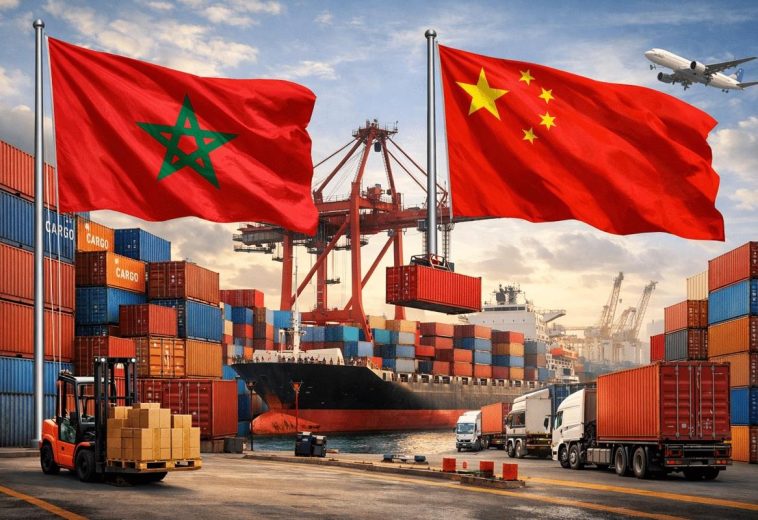

Can preferential access to one of the world’s largest consumer markets help African exporters compete more effectively in global trade? Morocco is seeking to turn China’s zero-tariff arrangement for African products into an opportunity for export expansion, following new government guidance clarifying how local businesses can qualify.
On 23 November 2026, Morocco’s Ministry of Industry and Trade outlined the conditions exporters must satisfy to benefit from duty-free access to China. The guidance provides practical direction on product origin, local content and customs documentation, giving Moroccan businesses a clearer framework for using the preferential trade arrangement.
READ ALSO:Clean Energy Ambition: How Morocco Is Positioning Itself as a Hydrogen Superhub
China introduced the zero-tariff measure on 1 May 2026 for products from the 53 African countries with which it maintains diplomatic relations. The arrangement covers all tariff lines, although exporters must satisfy the applicable rules of origin. For Morocco, the new guidance is particularly relevant because the country is among the African economies seeking to expand exports beyond traditional European markets.
Under the requirements outlined by Moroccan authorities, goods must either be wholly obtained in Morocco or contain at least 40 per cent local value, calculated on a free-on-board basis, and undergo their final substantial transformation in the country. Simple activities such as packaging, labelling, basic mixing, drying, salting or freezing do not automatically qualify a product for Moroccan origin.
The rules are designed to ensure that preferential access benefits genuine domestic production rather than businesses simply routing goods manufactured elsewhere through Morocco. Exporters must also comply with shipment requirements, including direct dispatch to China, subject to specified transit conditions. Certificates of origin are issued by Morocco’s Customs and Indirect Tax Administration.
The development comes against the background of a significant imbalance in Morocco’s trade with China. Bilateral trade increased by 25.1 per cent in 2025, but the relationship remained heavily weighted towards Chinese exports. Morocco imported approximately MAD114.1 billion worth of goods from China, while its exports to the market amounted to about MAD3.83 billion. The resulting trade deficit reached approximately MAD110.2 billion.
For Moroccan businesses, duty-free access could improve the price competitiveness of eligible products and create incentives to expand production for the Chinese market. Agriculture, fisheries, manufactured goods and other sectors with export potential could benefit, provided that producers can meet quality requirements, establish reliable supply chains and identify suitable buyers.
However, preferential tariffs alone cannot guarantee export growth. Businesses must understand Chinese consumer demand, comply with product standards, manage shipping costs and build dependable distribution relationships. The 40 per cent local-value requirement also places greater importance on domestic sourcing, processing and manufacturing capacity.
Morocco’s experience carries a wider lesson for African economies. Preferential market access becomes more valuable when countries have the industrial capacity to produce competitive goods, demonstrate their origin and meet international standards. Without these foundations, tariff advantages may remain underutilised.
For Africa, China’s zero-tariff arrangement offers an opportunity to rethink the structure of trade relations with a major global market. The challenge is to move beyond exporting predominantly raw commodities towards a stronger presence for processed agricultural products, manufactured goods and higher-value exports.
Morocco’s new guidance is therefore more than a customs clarification. It is a practical step towards helping domestic businesses understand and use a trade opportunity. Whether that opportunity produces a meaningful increase in exports will depend on the country’s ability to connect preferential access with productive capacity, quality assurance and competitive local industries.