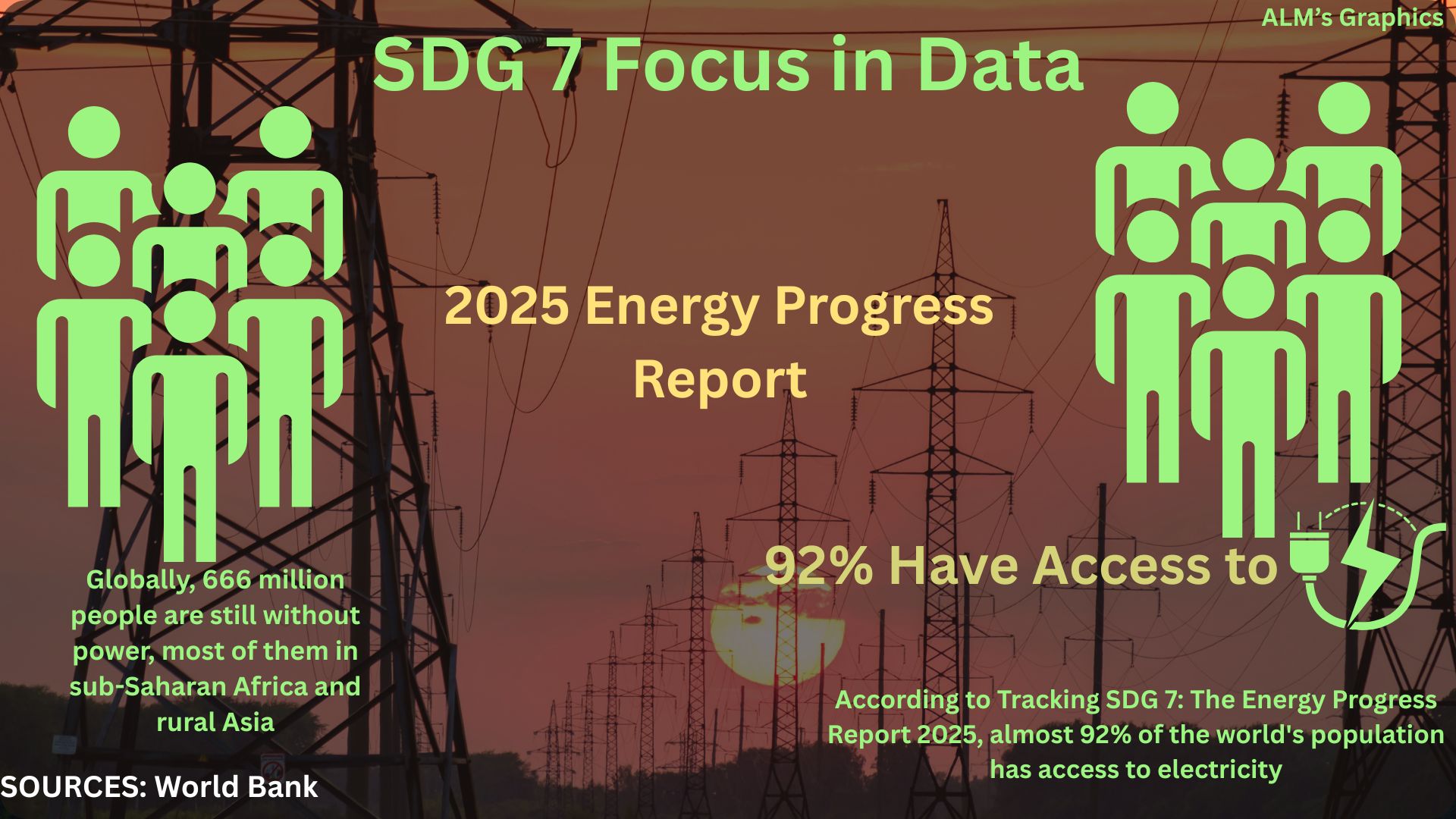
When world leaders adopted the United Nations Sustainable Development Goals in 2015, Goal 7 stood out as a powerful pledge: to ensure access to affordable, reliable, sustainable, and modern energy for all by 2030. Energy was not just another item on the development checklist; it was the golden thread tying together education, health, industry, and climate action. Ten years later, progress has been made, yet the latest Tracking SDG 7: The Energy Progress Report 2025 shows that millions remain trapped in darkness. Global electricity access has risen to 92%, meaning 666 million people are still without power, most of them in sub-Saharan Africa and rural Asia. The current rate of progress, though encouraging, is insufficient to deliver universal access by the 2030 deadline.
The world has undeniably made headway. In 2010, 1.2 billion people lived without access to electricity. By 2023, that figure had fallen to 666 million, as new connections finally began to outpace population growth. Central and Southern Asia led this transformation, reducing their electricity access deficit from 414 million in 2010 to just 27 million by 2023. Meanwhile, global renewable energy capacity climbed steadily, reaching 478 watts per capita in 2023, up nearly 13% from the previous year. Installed renewable energy capacity in developing countries has more than doubled since 2015, reflecting the declining costs and scalability of solar, wind, and hydro solutions.
READ ALSO: A Decade of Strategic Growth: Refining in Africa’s Energy Transition
International financial flows have also risen, albeit unevenly. In 2023, clean energy support to developing countries increased by 27% from 2022, reaching $21.6 billion. However, this remains below the 2016 peak of $28.4 billion. Crucially, most of this financing is debt-driven, 83% in 2023, while grants accounted for less than 10%. For the poorest countries, this imbalance raises fears of debt traps even in the pursuit of clean energy access.
The Shadow of Inequality
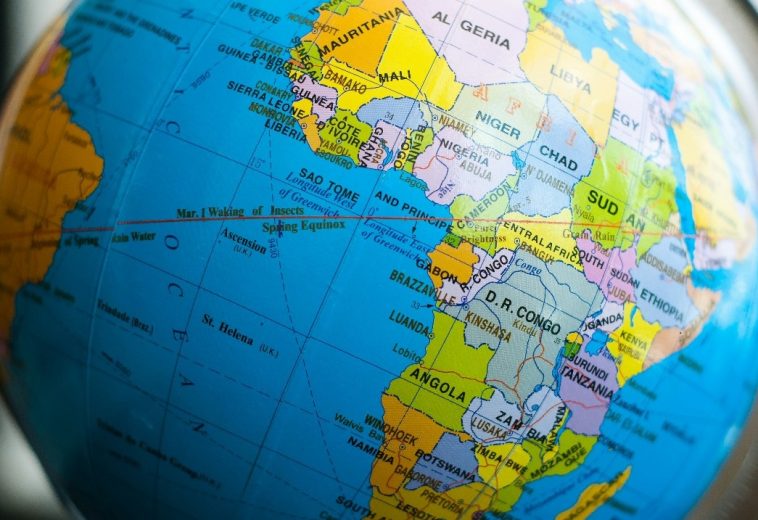
Beneath the headline numbers lie stark inequalities. Sub-Saharan Africa has become the epicentre of global energy poverty. The region accounts for 85% of the world’s unelectrified population, a sharp increase from 50% in 2010. While 35 million people in Africa gained electricity access in 2023, population growth offset most of the gains, reducing the number of people without power by only 5 million. By the year’s end, 565 million Africans still lived without electricity.
The rural–urban divide is particularly striking. In 2023, 84% of people without electricity lived in rural communities, often in conflict-prone or geographically isolated areas. In sub-Saharan Africa alone, 451 million rural residents remained in darkness, compared with much smaller deficits in urban areas. These disparities reveal the structural difficulties of extending centralised grid infrastructure to remote, sparsely populated, and fragile regions.
Cooking in the Shadows of Smoke
Electricity is only one side of the energy poverty story. Clean cooking access has stagnated dangerously. Globally, 74% of people had access to clean fuels and technologies for cooking in 2023, up from 64% in 2015. Yet more than 2.1 billion people still rely on firewood, charcoal, and kerosene, exposing them to toxic indoor air pollution. The health consequences are devastating: the World Health Organization estimates that millions die prematurely each year from cardiovascular and respiratory diseases linked to household smoke inhalation.
Sub-Saharan Africa remains the worst affected. Four in five families in the region cook with polluting fuels, and the number of people without access to clean cooking is growing by 14 million each year. Women and children bear the heaviest burdens—both in terms of health impacts and the hours lost daily in fuel collection. Without dramatic acceleration, only 78% of the global population will have access to clean cooking by 2030, falling short of SDG 7 targets.
Decentralised Solutions
Faced with the limitations of grid extension, decentralised renewable energy (DRE) solutions have emerged as the fastest and most cost-effective way to close the access gap. Solar home systems, solar mini-grids, and small-scale biogas plants are increasingly powering rural communities beyond the reach of national utilities. Between 2020 and 2022, 55% of all new electricity connections in sub-Saharan Africa came from DRE systems. By 2023, such solutions benefited more than 561 million people globally.
Off-grid solar alone is projected to be the least-cost solution for around 41% of those still without electricity. Yet scaling up DRE technologies requires significant investment—an estimated $95 billion is needed by 2030. At present, financing remains a bottleneck, with the off-grid solar sector attracting only $1.2 billion in investments during 2022–23. Bridging this gap will require both innovative financing models and stronger political commitment to integrating decentralised energy into national plans.
Financing the Future or Falling Short
The Energy Progress Report and World Bank’s findings converge on a sobering truth: inadequate and inequitable financing is the biggest obstacle to universal energy access. Developing countries, particularly in Africa, receive a fraction of the investment needed. In 2023, only two sub-Saharan African countries ranked among the top five global recipients of international clean energy flows. This mismatch reflects both the risk-averse nature of donors and the structural barriers facing fragile states, including weak regulatory frameworks and limited institutional capacity.
Experts argue that international public finance must play a catalytic role. Multilateral development banks, bilateral lenders, and climate funds need to expand concessional finance, mobilise grants, and deploy risk-mitigation instruments to crowd in private capital. Without such reforms, the least developed countries will remain locked in energy poverty even as wealthier regions march toward decarbonisation.
The Gendered Dimensions of Darkness
Energy poverty is not gender-neutral. Studies reveal that women-headed households in Africa and South Asia are disproportionately excluded from off-grid access, largely due to affordability constraints. Where electricity is available, its productive use in health, education, and income generation disproportionately benefits women and children. Conversely, the lack of access reinforces cycles of poverty, limiting opportunities for women’s empowerment and economic participation. Addressing SDG 7 must therefore integrate a gender lens, ensuring that women are not merely beneficiaries but also active participants in shaping energy policies and markets.
The Clock Ticks Towards 2030
With only five years left to achieve SDG 7, the world is racing against time. Experts warn that the current trajectory will leave hundreds of millions still without electricity and billions without clean cooking by 2030. Fatih Birol of the International Energy Agency has described the pace of expansion as “disappointingly slow,” particularly in Africa, where energy poverty undermines education, health, and development opportunities.
Francesco La Camera, Director-General of the International Renewable Energy Agency, stresses that renewables have already proven their affordability and scalability but require far greater investment to overcome infrastructure gaps. Stefan Schweinfest of the UN Statistics Division has warned that, despite advances, weak progress in energy efficiency and renewables risks derailing both the SDG and climate agendas. The World Bank has highlighted its Mission 300 initiative, launched with the African Development Bank, which aims to provide electricity access to 300 million people by 2030, a bold step, but still only half of Africa’s current deficit.
Achieving SDG 7 is inseparable from broader global agendas such as the Paris Agreement and the 2030 Agenda for Sustainable Development. Energy is both an enabler and a target, underpinning goals on health, education, gender equality, and climate. The High-Level Political Forum on Sustainable Development, which reviews progress on the SDGs, has underscored the need for strengthened cooperation between governments, private investors, and development institutions.
The path forward requires coordinated reforms in three areas: expanding concessional finance and reducing the cost of capital in low-income countries; accelerating decentralised renewable energy deployment to reach remote populations; and embedding clean cooking at the heart of public health, gender, and environmental policies. Without this three-pronged approach, the world risks leaving its poorest communities behind in the global energy transition.
A Light That Must Reach All
The promise of SDG 7 was never merely about electricity or technology. It was about dignity, opportunity, and justice. Today, as the world edges closer to 2030, the achievements are real but fragile. Ninety-two per cent global electricity access is a milestone worth celebrating, yet the 666 million people left behind, most of them in Africa’s rural heartlands remain a stark reminder of unfinished business.
If the global community acts decisively, mobilising finance, scaling decentralised renewables, and prioritising clean cooking, the vision of universal energy access can still be realised. But if complacency prevails, millions will continue to live and die in the dark, excluded from the promise of sustainable development. The countdown has begun, and the light must reach everyone.