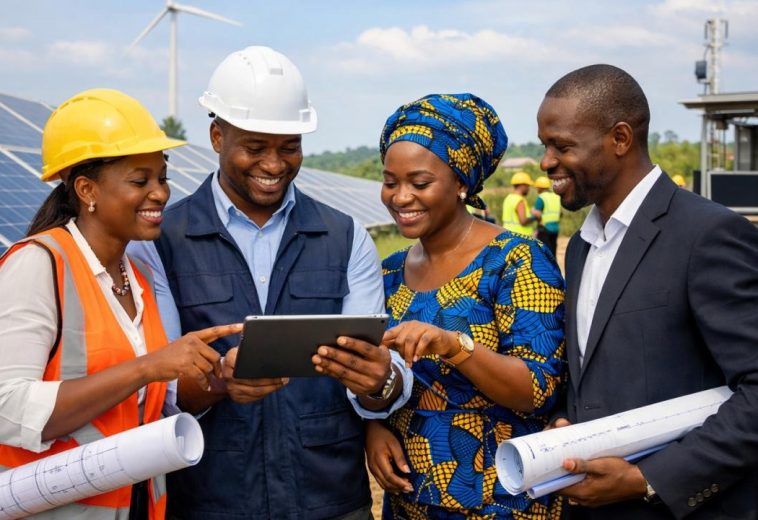
The inauguration of a new photovoltaic solar power plant in the Central African Republic (CAR) marks a historic milestone for the nation’s energy sector. This 50-megawatt (MW) solar facility, coupled with advanced battery storage, has the potential to significantly transform the country’s energy landscape, supporting economic growth, environmental sustainability and social development.
CAR’s 18.2% electricity access rate is among the world’s lowest. The sub-Saharan African average is 48%, while the global average exceeds 90%. Even those counted as “connected” endure frequent brownouts, forcing businesses and hospitals to rely on diesel generators. The functional access rate is therefore even lower than official figures suggest.
READ ALSO: Powering Rural Africa: Solar Mini-Grids Are Expanding Access to Electricity
Adding 50 MW of solar to CAR’s sub-90 MW installed capacity could significantly change the nation’s energy balance sheet. AfDB research shows that such generation leaps in low-base economies can unlock step-change GDP growth by enabling light manufacturing, agro-processing and digital services that were previously difficult to operate.
The 10 MWh Battery Energy Storage System addresses the reliability challenge that has plagued past renewable projects. Battery prices have dropped by more than 90% since 2010, making utility-scale storage increasingly viable. This helps ensure grid stability, frequency regulation and load-shifting for evening demand, delivering reliable, dispatchable power without diesel’s fuel costs or emissions.
The 10-month delivery period is significantly shorter than the typical three-to-five-year timeline for African utility-scale solar projects. This speed demonstrates proof of concept to sceptical investors, minimises capital costs and reduces disruption risks in fragile environments. The rapid-execution model offers a replicable template for conflict-affected nations.
Concessional finance from the Abu Dhabi Fund for Development, anchored by the UAE-CAR CEPA, exemplifies South-South investment that can bypass traditional constraints. Such agreements link infrastructure to trade facilitation, creating a pipeline from energy to industrial production. IRENA identifies risk-mitigation instruments such as these as an effective tool for attracting private capital.
Clean electricity for more than 300,000 households can unlock economic activity beyond lighting. Businesses lose 8% of annual sales to outages and spend 15% of operating costs on diesel self-generation. Utility-scale solar can cut electricity costs by 50–70%, enabling domestic agro-processing of cassava, coffee and cotton while retaining more value within the country.
Displacing diesel delivers fiscal and environmental savings. Sub-Saharan Africa consumes more than 40 billion litres of diesel annually for power generation, much of it subsidised. Reduced diesel imports can save scarce foreign exchange for health, education and security. Offsetting more than 50,000 tonnes of CO₂ annually also demonstrates that fragile states can pursue low-carbon pathways with appropriate support.
CAR has historically been within Russia’s sphere of influence through the Wagner Group’s security presence and mining concessions. The UAE’s entry offers a competitive, development-focused alternative. Gulf states are strategically diversifying their partnerships through mutual economic benefit, giving CAR more options and demonstrating how renewable infrastructure can strengthen sovereign agency.
Africa has 33 Least Developed Countries sharing many of CAR’s constraints. The World Bank’s Mission 300 explicitly identifies distributed renewables as a primary mechanism for connecting 300 million people by 2030. CAR’s model—modular solar plus storage, delivered rapidly through concessional finance provides a potential template that could reduce costs by up to 30% when replicated.
The Bangui solar plant nearly doubles effective generating capacity, providing firm, storage-backed power at record speed through a South-South partnership. It challenges the assumption that fragile states must wait for peace before achieving modern infrastructure. Instead, it demonstrates how infrastructure can help create the conditions for peace and prosperity. For a continent where 600 million people lack electricity, CAR offers an important example of what Africa’s sustainable energy future could look like.