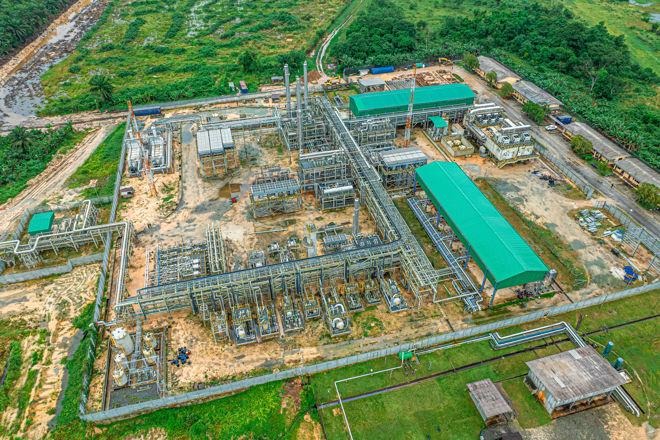
Nigeria is recording fresh direction in its drive to expand domestic energy supply, with domestic natural gas deliveries now exceeding 2 billion cubic feet per day (bcf/d) as the government seeks to increase supplies to power plants, industries and other productive sectors of the economy.
The milestone, announced on 2 October by Minister of State for Petroleum Resources (Gas), Ekperikpe Ekpo, comes as Nigeria intensifies efforts to build a stronger gas value chain and attract new investment into the sector. A further government update published on 5 October highlighted the same progress, alongside new infrastructure and investment figures.
READ ALSO: Africa Oil & Gas Leadership Reception set in Houston
Nigeria’s total gas production has also increased to approximately 7.5 bcf/d, up from about 6.8 bcf/d in 2023. At the same time, proven gas reserves have risen from 208.83 trillion cubic feet in 2023 to 215.19 trillion cubic feet as of January 2026, reinforcing the scale of the resource available to support the country’s energy and industrial ambitions.
The government is targeting production of 10 bcf/d by 2027 and 12 bcf/d by 2030, with growing demand expected from power generation, manufacturing, fertiliser and petrochemical production, liquefied natural gas, transportation and export markets.
For Nigeria, increasing domestic gas availability has implications well beyond the energy sector. Gas-fired power generation remains central to the country’s electricity system, while manufacturers and other businesses require reliable energy to operate competitively.
Greater availability of gas could therefore help address one of the longstanding constraints on Nigeria’s industrial development: the cost and reliability of energy.
Infrastructure development is central to the next phase of this expansion. The Obiafu-Obrikom-Oben (OB3) gas pipeline has reached completion and is being prepared for first gas. With a capacity of about 2 bcf/d, the pipeline is expected to unlock more than 500 million standard cubic feet per day (MMscf/d) of additional gas for the domestic market.
The Ajaokuta-Kaduna-Kano (AKK) pipeline, meanwhile, is about 95 per cent complete. Its development is expected to strengthen the movement of gas from the south towards northern Nigeria, expanding access to regions that have historically had more limited pipeline connectivity.
Investment is also beginning to play a larger role in the expansion. According to the government, ₦671 billion deployed through the Midstream and Downstream Gas Infrastructure Fund has attracted approximately ₦1.6 trillion in private investment across 31 projects and 205 infrastructure assets.
When fully operational, these projects are expected to deliver about 475 MMscf/d of additional gas to the domestic market. The government is targeting approximately US$30 billion in gas-sector investment by 2030.
Nigeria is also seeking to translate greater gas availability into wider economic opportunities. The government has identified gas as an important component of its industrialisation and economic diversification strategy, particularly as the country seeks to reduce its dependence on crude oil revenues.
The latest figures nevertheless come with an important implementation challenge. Earlier NUPRC data showed that average domestic gas delivery stood at 2.05 bcf/d in the first half of 2026, against a Domestic Gas Delivery Obligation allocation of 3.16 bcf/d, indicating that infrastructure and supply gaps remain.
Closing that gap will be critical to ensuring that Nigeria’s abundant gas resources translate into reliable energy for businesses and households.
The current momentum, however, provides a significant foundation. With domestic supply crossing 2 bcf/d, major pipelines approaching operation and billions of naira in public funding attracting private capital, Nigeria is positioning gas as more than an export commodity.
It is increasingly being positioned as an engine for power, manufacturing, investment and economic diversification. Greater domestic gas supply could support more reliable power generation, lower energy constraints for industries and strengthen Nigeria’s efforts to build a more productive and diversified economy.
The next priority is turning production growth and infrastructure investment into dependable gas delivery, ensuring that more of Nigeria’s natural resources directly support domestic industrial and economic activity.