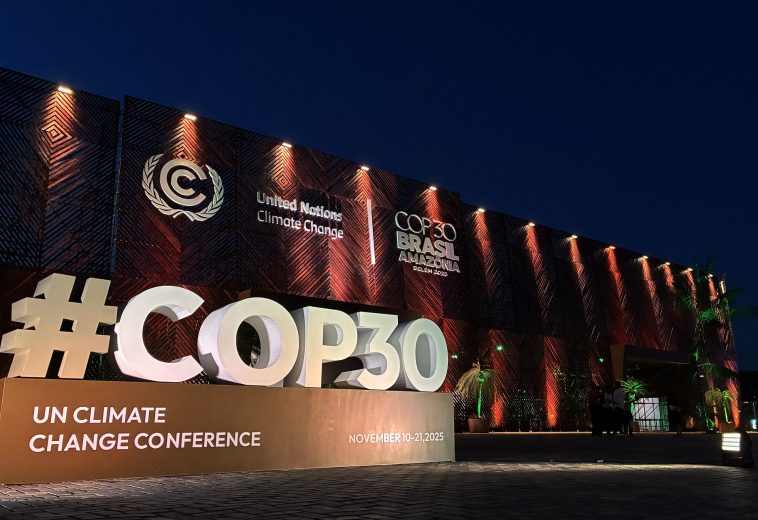
As the world converged in Belém, Brazil, for the 30th Conference of the Parties (COP30), a familiar tension resurfaced: the widening gulf between climate pledges and tangible action. Yet, amid this global dialogue, Africa’s voice has grown louder, clearer, and more assertive. The continent’s leaders arrived not as passive recipients of aid but as architects of a shared future, demanding that the rhetoric of equity be matched by concrete financial commitments.
COP30 has become a defining moment for developing nations. The summit reaffirms the centrality of the UNFCCC Paris Agreement framework and the new Global Goal on Climate Finance (GCF), which seeks to mobilise at least US$1.3 trillion annually by 2035 to support climate adaptation and mitigation, a step towards correcting long-standing financial inequities in climate policy.
READ ALSO: What Went Down at Day 1 of COP30
The call for climate justice echoed powerfully through the halls of COP30, resonating especially from African delegations. The African Union Chairperson, H.E. Mahmoud Ali Youssouf, set the moral tone for the continent’s participation, reminding the world that Africa contributes less than 4% of global emissions yet endures the worst of its consequences.
AUC Chairperson H.E. Mahmoud Ali Youssouf called for urgent climate justice, noting that though Africa contributes less than 4% of global emissions, it bears the brunt of the crisis.
He urged industrialised nations to honour adaptation finance pledges; “not as charity, but as a moral & historical responsibility.” Africa, he said, is not waiting: through the AU Climate Strategy (2022–2032), the Decade of Smart Agriculture, the Blue Economy Strategy, & Mission 300 for clean power access, the continent is advancing resilience and prosperity.
He called for the full operationalisation of the Global Goal on Adaptation, moving from plans to action, & ensuring predictable, equitable finance for vulnerable nations.
Nigeria’s New Climate Architecture
At the heart of Africa’s engagement stood Nigeria’s Vice President, Senator Kashim Shettima, who embodied a growing African pragmatism, one that weds rhetoric to results. Representing President Bola Ahmed Tinubu, Shettima called for a shift from promises to performance, declaring, “Let COP30 be remembered as the moment the world moved from pledges to performance, from ambition to action, and from dialogue to delivery.”
Nigeria’s latest submission of its Third Nationally Determined Contribution (NDC) in September 2025 underscores its resolve: a 32% emissions reduction target by 2035, supported by the newly launched National Carbon Market Framework and Climate Change Fund. These initiatives are designed to channel billions into clean energy and adaptation investments, anchoring Nigeria’s goal to attract sustainable finance.
Shettima further unveiled a five-year Carbon Market Roadmap, laying the groundwork for an Emissions Trading System and Carbon Tax Regime. He affirmed that Nigeria’s carbon strategy aligns with Article 6 of the Paris Agreement, ensuring transparency in carbon credit generation and trade. This approach, he noted, “represents not just aspiration but a solemn national commitment to preserve the planet for future generations.”
Ethiopia’s Green Legacy and Africa’s New Vision of Agency
Ethiopian Prime Minister Abiy Ahmed Ali delivered one of COP30’s most stirring interventions, announcing that “We are not here to negotiate our survival. We are here to build the world of the next climate.” Ethiopia’s Green Legacy Initiative, which has already overseen the planting of over 48 billion trees since 2019, stands as a flagship example of African-led environmental transformation.
Abiy also spotlighted the proposed Grand Squadron Project, a new dam initiative poised to boost renewable power generation while reinforcing food and water security. Ethiopia’s approach aligns with the African Union’s Agenda 2063, affirming that Africa’s future lies in its own capacity to innovate, a sentiment increasingly shared among leaders on the continent.
Kenya’s Voice of Caution and Collective Responsibility
Kenya has once again called for bold and decisive global action on climate change, with Deputy President Kithure Kindiki urging world leaders to establish clear timelines for phasing out fossil fuels as the 30th UN Climate Change Conference (COP30) commenced in Belém, Brazil.
Delivering Kenya’s national statement on behalf of President William Ruto during the Leaders’ Summit, Kindiki highlighted that the country’s transition to clean energy is already significantly advanced, with 93 per cent of its electricity currently generated from solar, wind, and geothermal sources.
He noted that this achievement has earned Kenya international recognition and firmly positions the nation to attain 100 per cent green energy by 2030. “Universal electrification by 2030 is now within reach,” Kindiki declared, emphasising that electricity access has expanded to 75 per cent, reaching 10.6 million of Kenya’s 15.6 million households, largely driven by the government’s Last-Mile Connectivity Programme.
The Deputy President further stated that Kenya is reskilling its workforce to meet the demands of the green transition while mobilising about USD 600 billion needed to achieve a full shift to clean energy. He also reaffirmed that the country’s target to phase out biomass cooking by 2028 remains firmly on track.
However, Kindiki cautioned that Kenya’s progress, and that of other developing nations, could remain unrealised unless climate finance pledges are honoured, global financial systems are reformed to improve access to capital, and climate policies are inclusive, prioritising women, youth, and farmers to ensure the equitable distribution of green economy benefits.
His remarks set the tone for critical discussions at COP30, where delegates are expected to intensify negotiations on energy transition, adaptation financing, and the future of fossil fuels.
Namibia’s Bold Stand
One of COP30’s most defining voices emerged from Namibia’s newly elected President, Dr. Netumbo Nandi-Ndaitwah, whose powerful address has been described as Africa’s climate awakening. “Africa contributes the least to climate change, yet we suffer the most,” she declared, adding that “Africa will no longer beg, Africa will lead.”
Namibia’s Nationally Determined Contributions (NDCs) outline 17 mitigation and 34 adaptation actions, targeting a reduction of 11.9 million tonnes of CO₂. Achieving this ambition will cost an estimated N$285 billion (US$14.5 billion), with N$247 billion (US$12.6 billion) expected from international partners. These figures highlight the stark reality that while Africa’s climate ambition is immense, its fiscal space remains constrained.
The Namibian President called for reform of the global financial system, particularly to address high borrowing costs faced by developing countries due to inflated risk perceptions. Her intervention echoed a wider consensus at COP30 that climate finance must be accessible, transparent, and fair.
Under her administration, Namibia is also spearheading a Green Hydrogen Strategy, including the launch of the Oshivela Green Iron Plant, one of the world’s first zero-emission industrial-scale projects, expected to avoid 27,000 tonnes of CO₂ emissions annually. These initiatives position Namibia not as a climate victim but as a leader in green industrialisation, demonstrating Africa’s ability to define the parameters of a sustainable future.
Europe’s Support and the “Baku to Belém Roadmap”
Europe’s climate diplomacy has recognised Namibia’s leadership. EU Ambassador Ana-Beatriz Martins praised the country’s efforts, noting that the EU and its member states remain the world’s largest providers of public climate finance, contributing N$634 billion (approx. €32 billion) in 2024 and mobilising an additional N$220 billion (approx. €11 billion) in private investment.
She cited the “Baku to Belém Roadmap”, launched to boost support for developing nations to US$1.3 trillion annually by 2035, as a crucial global framework to close the climate finance gap. The initiative complements the UNFCCC’s drive toward a New Collective Quantified Goal on Climate Finance (NCQG), a central feature of post-Paris negotiations.
This roadmap represents a shift in global climate governance, moving beyond fragmented aid models toward shared accountability and structured investment in adaptation, resilience, and clean energy transition areas where Africa has much to contribute.
A Global Call to Action
The global south’s message at COP30 has been unequivocal: climate action without justice is unsustainable. From Nigeria’s carbon market framework to Namibia’s hydrogen revolution, African nations are demonstrating capacity, innovation, and leadership. Yet, without reforming the international financial architecture, their ambition risks being undermined by debt, delayed disbursements, and inequitable financing.
Brazil’s President, Luiz Inácio Lula da Silva, summarised this urgency in his opening address: “COP30 will be the COP of truth. It is time to take the warning from science seriously.” He urged nations to phase out fossil fuel subsidies and invest decisively in renewable energy, especially for the Global South, which remains most exposed to the climate crisis.
Africa’s Moment of Resolve
As COP30 progresses, one truth has become clear: Africa no longer seeks sympathy; it seeks partnership. The continent’s leaders have reframed the conversation from vulnerability to value, asserting that Africa is central to global climate stability. From Ethiopia’s reforestation to Nigeria’s carbon markets and Namibia’s hydrogen revolution, Africa’s agency is rising on its own terms.
COP30, therefore, is more than a climate conference. It is a reckoning, a test of whether the world can transform its promises into action and its pledges into justice. And at the heart of that test stands Africa, no longer waiting to be heard, but determined to lead the conversation about the planet’s shared future.