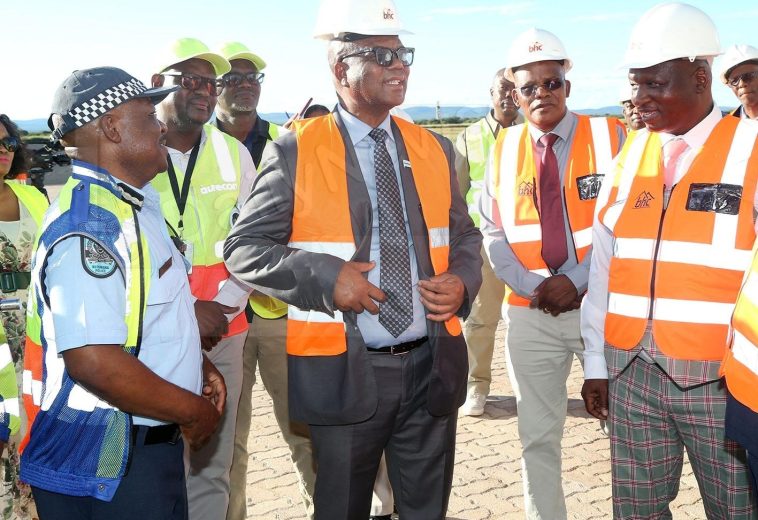
Can Botswana turn infrastructure investment into a more diversified and competitive economy? President Duma Boko’s 2026 State of the Nation Address has placed that ambition at the centre of the country’s development agenda, outlining major projects in water, transport, energy and industrial infrastructure.
Addressing the nation in Gaborone on 9 November, Boko said the government was working to establish an enabling environment for industrialisation and investment. Among the most significant projects are the proposed 1,600-kilometre Chobe-Zambezi Water Transfer Scheme and the Trans-Kalahari Railway, both of which have the potential to reshape the country’s economic geography.
READ ALSO: Botswana’s De Beers Stake: Greater Influence, Greater Financial Exposure
The water transfer scheme is intended to strengthen water security, a critical requirement for agriculture, manufacturing and growing urban centres. The government is also integrating it with the Zambezi Agro-Commercial Development Project in Pandamatenga, where improved water access could support agricultural production and food security. In a country where water availability is a major development constraint, infrastructure of this scale could help unlock productive activity. However, its long-term value will depend on financing, environmental safeguards, water-sharing arrangements and the affordability of supply.
The Trans-Kalahari Railway represents another strategic ambition. The proposed 1,600-kilometre project has been delayed for more than a decade and is intended to strengthen regional transport connections. Boko said bankable feasibility studies for the two major projects had been concluded, with contractor procurement expected during the 2027/2028 financial year. This is an important step, but it also means that construction remains ahead rather than an immediate outcome. The next challenge will be converting planning into financially sustainable delivery.
Botswana is also seeking to strengthen its position as an investment destination through airport-linked development. The President reported that 82 serviced plots at Sir Seretse Khama International Airport had been transferred to the Special Economic Zone Authority, with the first investor lease signed. Four strategic factory shells were nearing completion, with occupation projected for April 2027.
A broader New Airport City development, valued at 25.5 billion pula, is being undertaken through a partnership involving the Botswana Development Corporation and ALBADDAD Holding and its parent company, Alfateen. The development includes a proposed 124,000-square-metre international exhibition and convention centre. The Botswana Development Corporation’s land contribution, valued at approximately 198 million pula, secures a five per cent golden equity shareholding. If successfully delivered, the project could expand opportunities in business tourism, logistics, events and related services.
Energy investment is another part of the industrialisation strategy. Boko reported that the Mmadinare and Jwaneng solar power plants had added 200 megawatts to the national grid since the previous State of the Nation Address. He also reported a 62 per cent reduction in electricity imports, from 492 gigawatt-hours in the corresponding period of 2025/2026 to 187 gigawatt-hours in 2026/2027. The government attributed the improvement to increased domestic generation and improved operational readiness at Morupule B Power Station.
Reliable and affordable electricity is essential if Botswana is to attract energy-intensive industries, expand manufacturing and improve the competitiveness of local businesses. Solar generation can contribute to that objective, although sustaining supply will also require investment in grid infrastructure, storage and dependable backup capacity.
The government’s infrastructure agenda is unfolding against the need to diversify an economy heavily exposed to the diamond market. Transport corridors, water security, electricity and serviced industrial land can help create the conditions for new economic activity. But infrastructure does not automatically produce industrial growth. Investors also require predictable regulation, skilled workers, access to finance, efficient public services and markets for their products.
The test for Botswana will therefore be whether these projects move beyond announcements and feasibility studies into transparent procurement, timely construction and productive use. Their success should be measured by the businesses they enable, the jobs they create, the reliability of essential services and the extent to which they strengthen domestic and regional value chains.
Botswana’s infrastructure ambitions reflect a wider African development priority: building the foundations that allow economies to produce more, trade more efficiently and create opportunities beyond traditional sources of revenue. For the country, the next phase is to turn that ambition into carefully financed and effectively managed projects capable of supporting long-term industrialisation.