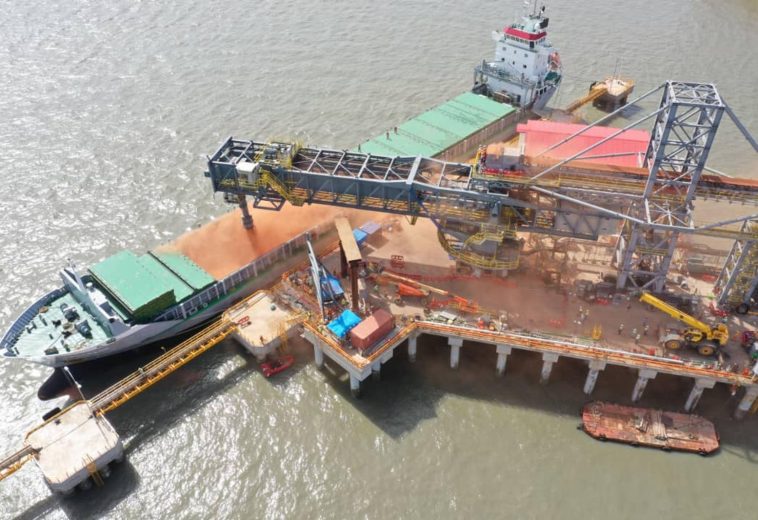
Zambia’s state-owned mining investment company, ZCCM Investments Holdings (ZCCM-IH), is preparing to invest approximately $2.7 billion over the next decade in mining, mineral trading and power generation. The strategy is designed to strengthen the country’s position in the global copper industry while ensuring that a greater share of the economic value generated by its mineral resources remains within Zambia.
Unveiled on 16 November 2026, the company’s 2026–2035 strategic plan aligns with the national ambition to increase annual copper production to three million metric tonnes by 2031. This would represent more than three times the 890,346 tonnes recorded in 2025. The plan also seeks to expand ZCCM-IH’s participation in exploration, mineral processing, energy and commercial trading, moving it beyond its traditional role as a shareholder in mining ventures.
READ ALSO;Zambia’s Copper Comeback: Mining Investments Power a New Era of Economic Growth
The financing structure combines approximately $704.2 million in planned corporate borrowing, $300 million in equity and between $1 billion and $1.7 billion in targeted project financing from partners and development finance institutions. Chief Executive Officer Kakenenwa Muyangwa has also described the company’s intention to secure about $700 million in borrowing and up to $1.7 billion from potential partners. These figures represent financing targets, not funds already secured. Their availability will depend on project feasibility, approvals and the conclusion of financing agreements.
The copper production target is national in scope, and ZCCM-IH’s programme will be only one part of the effort required to achieve it. The company has interests across several established mining operations, but expanding output will also require new discoveries, exploration, mine development and sustained private-sector investment. Geological discoveries must progress through feasibility assessments, permitting, construction and commissioning before they can contribute meaningfully to production.
Recent production figures illustrate the scale of the challenge. Zambia produced approximately 683,003 tonnes of copper between January and September 2026, compared with 672,908 tonnes during the corresponding period in 2025, representing growth of about 1.5 per cent. Although output has improved, reaching three million tonnes annually within the government’s target period will require a substantial acceleration in investment and production capacity.
Power remains another important constraint. ZCCM-IH’s strategic plan targets a gross generation portfolio of 3,022 megawatts by 2035. This is a portfolio target that includes existing interests and proposed projects at different stages of development, rather than 3,022 megawatts of newly commissioned electricity already available to the mining sector. The distinction matters because Zambia’s electricity system remains vulnerable to supply shortages.
The International Monetary Fund estimated the country’s electricity deficit at nearly 707 megawatts in 2025. It also reported that hydropower accounted for approximately 81 per cent of installed generation capacity as of October 2025, leaving the system exposed to drought-related disruptions. Expanding and diversifying electricity supply will therefore be essential if mining operations are to increase production without intensifying pressure on households and other industries.
Another important element of the strategy is ZCCM-IH’s approach to mineral revenue. At Kansanshi, the company retains a 20 per cent shareholding but receives a 3.1 per cent royalty on gross revenue in place of its former dividend rights. The arrangement provides a more predictable income stream because payments are linked to sales rather than the mine’s declared profitability. ZCCM-IH has indicated that it wants to negotiate similar arrangements with other mining partners, although the commercial terms will need to reflect the financial conditions of each operation.
The company is also seeking a stronger role in mineral trading. Its plans include obtaining a share of metals produced by investee companies for direct marketing, building commercial expertise and increasing Zambia’s participation in the mineral supply chain. This approach reflects a wider regional interest in giving resource-producing countries greater involvement in the marketing and trading of their minerals, rather than limiting their participation to extraction and export.
The strategy complements Zambia’s October 2026 Metals and Minerals Country Compact developed with the World Bank Group. The ten-year framework seeks to attract approximately $20 billion in private mining investment and $10 billion for enabling infrastructure. It also identifies potential employment of up to 200,000 direct jobs in sustained mining operations and an additional 300,000 indirect and induced jobs. Importantly, the Compact emphasises local suppliers, skills development, infrastructure and mineral value addition as part of a broader industrialisation agenda.
Several factors will determine whether these ambitions translate into lasting economic benefits. ZCCM-IH must secure financing on sustainable terms, attract capable partners, advance commercially viable exploration projects and bring proposed energy developments to completion. Royalty arrangements must also balance predictable public-sector income with the need to maintain attractive conditions for mine operators and investors.
For Zambia, the opportunity extends beyond increasing copper exports. Stronger domestic processing, equipment supply, engineering services and manufacturing could create additional economic activity around the mining sector. Copper is an essential input for electricity networks, renewable energy systems and modern manufacturing, giving Zambia an opportunity to participate more deeply in the industries supporting the global energy transition.
The real measure of the strategy will not be the $2.7 billion investment target alone. It will be whether production increases, reliable power becomes available, local businesses secure opportunities in the mining value chain and public revenues support wider national development. If these priorities are delivered together, ZCCM-IH’s plan could help turn Zambia’s mineral wealth into a stronger foundation for industrial growth and long-term prosperity.