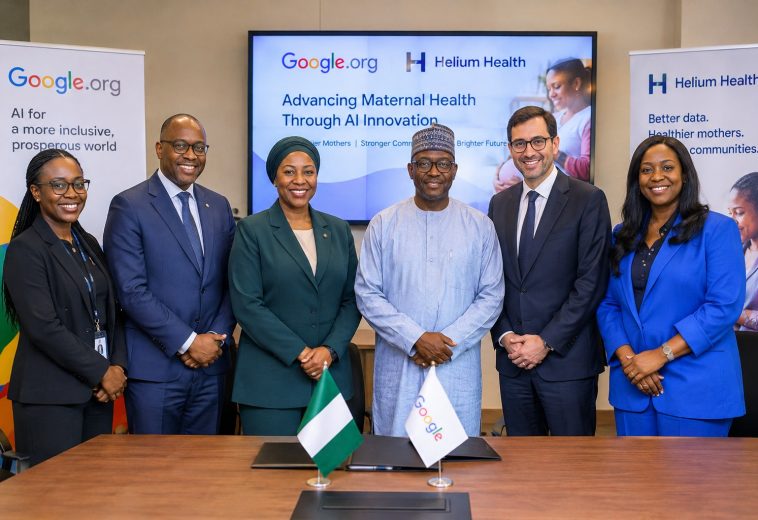
Can artificial intelligence help save more African women from preventable pregnancy-related deaths? A new partnership between Nigerian health technology company Helium Health and Google.org is seeking to demonstrate how locally developed digital solutions can strengthen maternal healthcare, improve clinical decisions and extend access to essential services.
Announced on 4 November 2026, the initiative will deploy clinical artificial intelligence tools through Helium Health’s maternal healthcare programme, HeliumMum, across Lagos, Delta, Kano and Oyo states. Lagos will serve as the primary operational launchpad, following the presentation of the implementation roadmap to Governor Babajide Sanwo-Olu by representatives of Google and Helium Health.
READ ALSO: Two Million by 2030: Africa’s Ambitious Plan for Community Health Workers
Helium Health has been selected as one of 15 global organisations under the $30 million Google.org Impact Challenge: AI for Government Innovation. The Nigerian company has secured a reported $2.5 million in funding, alongside access to technical support from Google engineers and AI product specialists.
The programme aims to reach an additional 1.9 million women over three years and contribute to a 30 per cent reduction in maternal mortality. These are programme targets rather than guaranteed outcomes, but they reflect the scale of ambition behind the initiative.
The need is particularly urgent in Nigeria. Estimates published by the World Health Organisation and partner United Nations agencies put the country’s maternal mortality ratio at 993 deaths per 100,000 live births in 2023. Nigeria recorded approximately 74,559 maternal deaths that year, representing more than a quarter of the estimated global total.
For a country with a large population and substantial differences in healthcare access between urban and rural communities, the challenge extends beyond the availability of hospitals. Delayed identification of complications, inadequate clinical information, shortages of skilled personnel and weak referral systems can all increase risks for pregnant women.
HeliumMum is designed to address some of these gaps by using AI-powered clinical decision-support tools to help identify potential pregnancy complications earlier and connect women with appropriate healthcare providers. Its integration with electronic medical records is intended to support healthcare professionals with relevant information while giving public authorities better data for planning and service delivery.
The company says its maternal health initiatives have already reached more than 3.5 million women over the past decade. The new funding provides an opportunity to build on that experience and extend the programme’s reach.
However, the effectiveness of AI in healthcare will depend on more than the technology itself. Reliable patient information, trained health workers, functional referral facilities, electricity, connectivity and strong data-protection safeguards will be essential. AI can support clinical decisions, but it cannot replace qualified medical professionals or compensate for facilities that lack the capacity to provide emergency care.
The programme also raises an important question for African health systems: how can governments turn technology partnerships into lasting public infrastructure? Deployments across four states could provide useful evidence on implementation costs, clinical outcomes and the practical challenges of using AI in primary healthcare. Transparent evaluation will be necessary to establish whether the intervention improves early detection and access to treatment.
For Nigeria, the wider opportunity lies in strengthening the relationship between domestic technology companies, public institutions and international partners. Rather than treating AI as an imported solution, the country can build on local expertise to develop tools around its own healthcare priorities.
The success of this initiative will ultimately be measured not by the sophistication of its software, but by whether more women receive timely care, avoid preventable complications and safely return home after childbirth. If the programme delivers on its objectives, it could offer a model for applying African health-tech innovation to one of the continent’s most urgent development challenges.